 Apipasta with vitamins 15kg
 Beecomplet® Spring 14Kg
 Beekeeper suit with round veil
 Oxalic acid 1kg
 Beeswax Foundation 5kg
 Fresh royal jelly 20g
 Classic honey jar 1kg comb-lines TO77 - Pack of 16 units
 Promotor L Apis 1 litre
- Out of stock

 Share in WhatsApp
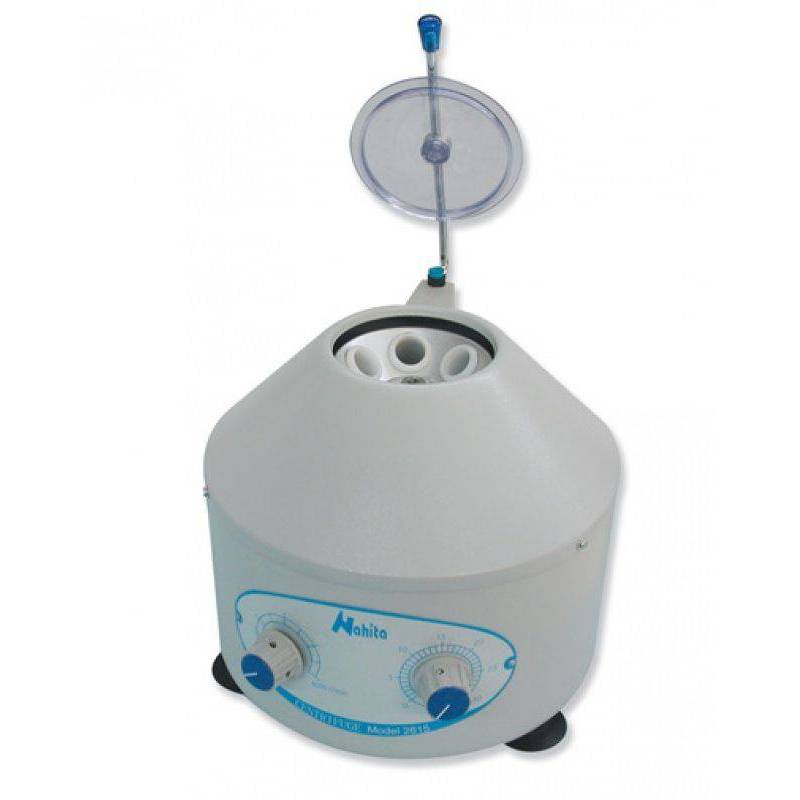
Compact and versatile centrifuge for semen homogenization and honey pollen analysis. Perfect for queen breeders and beekeeping labs.
Angle-rotor bench centrifuge: 6 tubes of 15 ml, up to 4000 rpm and a 0 to 60 minute timer.
Two different trades in the same machine. In queen rearing it homogenises drone semen with the diluting solution before insemination; in honey quality control it concentrates the pollen grains of a diluted sample at the bottom of the tube. The two uses rarely share a bench, so it is worth knowing which one you are buying it for.
01 · WHY SPIN THE POLLEN
The pollen grains in a honey measure from a few tens of microns upward, and in a sample diluted in water they would take hours to settle by gravity, if they settled at all. Centrifuging takes them to the bottom of the tube in minutes and leaves a sediment that can be mounted on a slide.
It is worth being clear about what it does and does not do: the machine prepares the sample. The botanical identification is then done by a trained person at the microscope, and it is that reading, not the machine, that says anything about the origin of a honey.
02 · IN INSEMINATION, HOMOGENISING
In instrumental insemination the semen is collected from several drones and diluted; until it is homogenised, the charge that goes into the capillary does not represent every donor equally. The centrifuge is what makes that mixture uniform before the syringe is loaded.
It is a laboratory step, not an apiary one: it belongs on the same bench as the syringes and the capillaries, not out at the hives.
03 · WHAT TO CHECK WHEN BUYING
The rotor is an angle rotor and takes 6 tubes of 15 ml, the most widespread conical laboratory tube format. If your protocols work with another volume, that is the first thing to check.
The timer runs from 0 to 60 minutes and the speed reaches 4000 rpm. It runs on 220 V and is a compact bench unit, meant for a worktable rather than a large laboratory bench.
04 · BEFORE YOU BUY
A laboratory device in a beekeeping shop: worth bounding.
| ✓ FITS | 6 tubes of 15 ml, up to 4000 rpm, timer 0 to 60 min, 220 V supply. |
| ⚠ NO CONSUMABLES | It does not include tubes, the diluting solution for semen, or any microscopy material. |
| ✕ IT ANALYSES NOTHING | It prepares the sample; it does not identify pollens or determine the origin of a honey. That is microscope work, and the work of someone who can read it. |
| Type | Bench mini centrifuge, angle rotor |
|---|---|
| Capacity | 6 tubes of 15 ml |
| Maximum speed | 4000 rpm |
| Timer | 0 to 60 minutes |
| Supply | 220 V |
| Uses | Homogenising semen in instrumental insemination · concentrating pollen sediment in honey samples |
| Reference | CR0202 |
Compact and versatile centrifuge for semen homogenization and honey pollen analysis. Perfect for queen breeders and beekeeping labs.
check_circle
check_circle