 Apipasta with vitamins 15kg
 Beecomplet® Spring 14Kg
 Beekeeper suit with round veil
 Oxalic acid 1kg
 Beeswax Foundation 5kg
 Fresh royal jelly 20g
 Classic honey jar 1kg comb-lines TO77 - Pack of 16 units
 Promotor L Apis 1 litre
- To order

 Share in WhatsApp
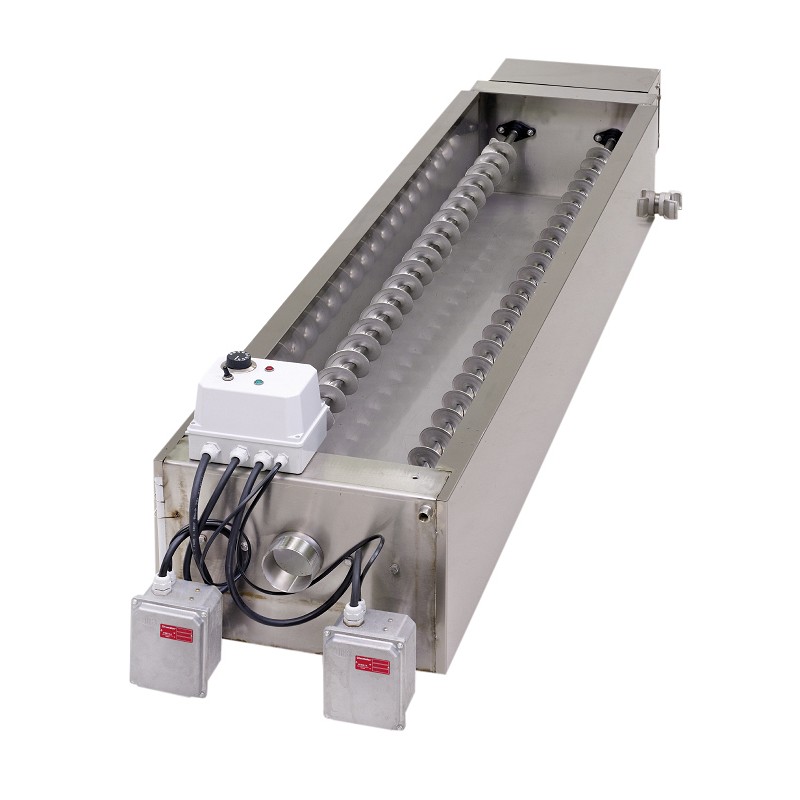
Twin-auger heated blender with a hot-water jacket: homogenises and tempers the honey-and-cappings mix to 35-40 °C before the spinner.
It sits between the uncapper and the cappings spinner, and without it the spinner does not separate properly. Honey comes from the extractor and cappings from the uncapper. This machine brings them together, works them with two augers and holds them at temperature until the spinner calls for them. A 2.5 kW element and a 1.5-metre trough.
01 · NOT A MIXER, A BUFFER
Homogenising and tempering is half the work. The other half is holding: while the cages of a batch spinner are loaded, emptied and cleaned, the uncapper keeps producing and honey keeps coming out of the extractor. That material has to go somewhere.
It stays here, stirred and at temperature, until there is room. Without that buffer the whole line runs at the spinner's pace.
02 · 35-40 °C IS THE HONEY'S CEILING
The working range was not chosen for convenience: above 40 °C honey rises in HMF and loses diastase. In other words, this machine's margin ends exactly where the product's margin ends.
It is worth keeping in mind, because the self-discharging spinners ask for more — they talk about 38-42 °C and advise leaning towards 41-42 — and that is already past the ceiling. The call is yours and it is legitimate, but it is a quality decision, not a machine setting: you trade analytical freshness for throughput.
03 · WHY TWO AUGERS AND NOT ONE
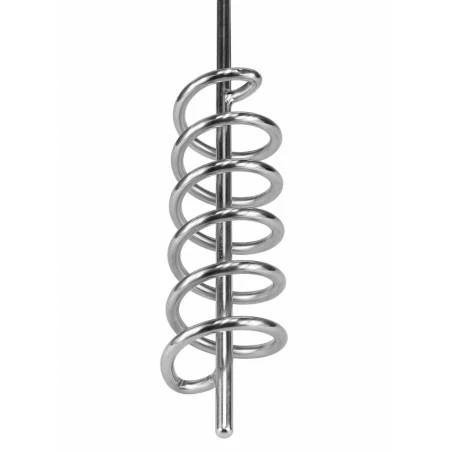
A single auger channels: it pushes down the middle and lets the cappings, far less dense, separate and float. What would reach the spinner is wax on one side and honey on the other, and then density separation has nothing left to separate.
With two augers the mix stays turned over end to end and leaves as a uniform paste. That is the inlet condition every cappings spinner assumes and none explains.
04 · THE WATER IS THE BAIN-MARIE
The trough has a double bottom and a hot-water wall: the 2.5 kW heat the water in the jacket, and it is the water that spreads the heat across the whole surface. An element in direct contact with the mix would create a local spot well above 40 °C, and that is where honey is spoiled.
It is the same principle used by heated maturers and the melting tanks in our range. When a product has a narrow thermal ceiling, heat is spread; it is never applied.
05 · WHICH SPINNER IT FEEDS
It is designed for self-discharging cappings spinners of the Spinfloat type, which run continuously and need a steady, tempered flow. It is the upstream piece of that line, not an accessory.
If yours is one of the classic cage or batch machines, it is still needed for the buffering: it is what lets you keep uncapping while you empty the cages.
06 · BEFORE YOU BUY
An in-line stage, not a stand-alone machine.
| ✓ A GOOD FIT | Feeding a cappings spinner continuously: homogenises, tempers to 35-40 °C and buffers. |
| ⚠ IT SEPARATES NOTHING ON ITS OWN | It goes between the uncapper and the spinner. With no spinner behind it, it serves no purpose. |
| ✕ IT DOES NOT DECRYSTALLISE HONEY | At 40 °C glucose crystals do not dissolve. That asks for more heat, and more heat is another decision. |
| Function | Homogenise, temper and buffer honey with cappings |
|---|---|
| Augers | Two screw augers |
| Working temperature | 35 to 40 °C |
| Heating | Double bottom and hot-water wall |
| Element | 2.5 kW |
| Stated dimensions | 1500 mm long · 350 mm deep |
| Material | Stainless steel |
| Position in the line | Between the uncapper and the cappings spinner |
| Manufacturer | Icko |
| Reference | JE1541 |
check_circle
check_circle