 Apipasta with vitamins 15kg
 Beecomplet® Spring 14Kg
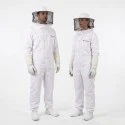 Beekeeper suit with round veil
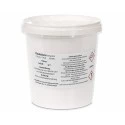 Oxalic acid 1kg
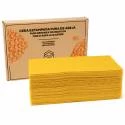 Beeswax Foundation 5kg
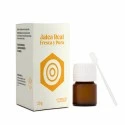 Fresh royal jelly 20g
 Classic honey jar 1kg comb-lines TO77 - Pack of 16 units
 Promotor L Apis 1 litre

 Share in WhatsApp
Buy it now and receive it between Thursday, 17 September and Monday, 21 September with Ontime
0.38 mm THICKNESS | 33 cm LENGTH |
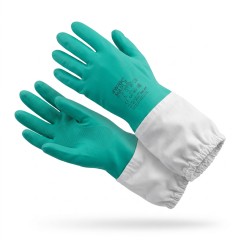
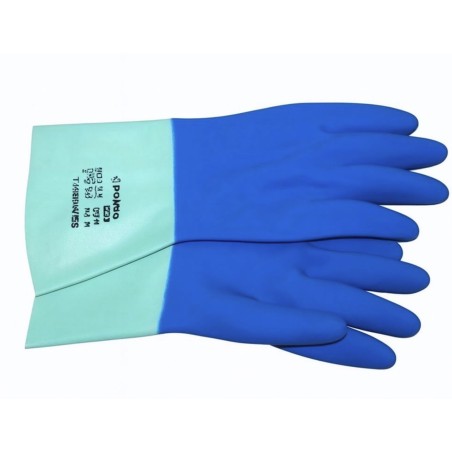
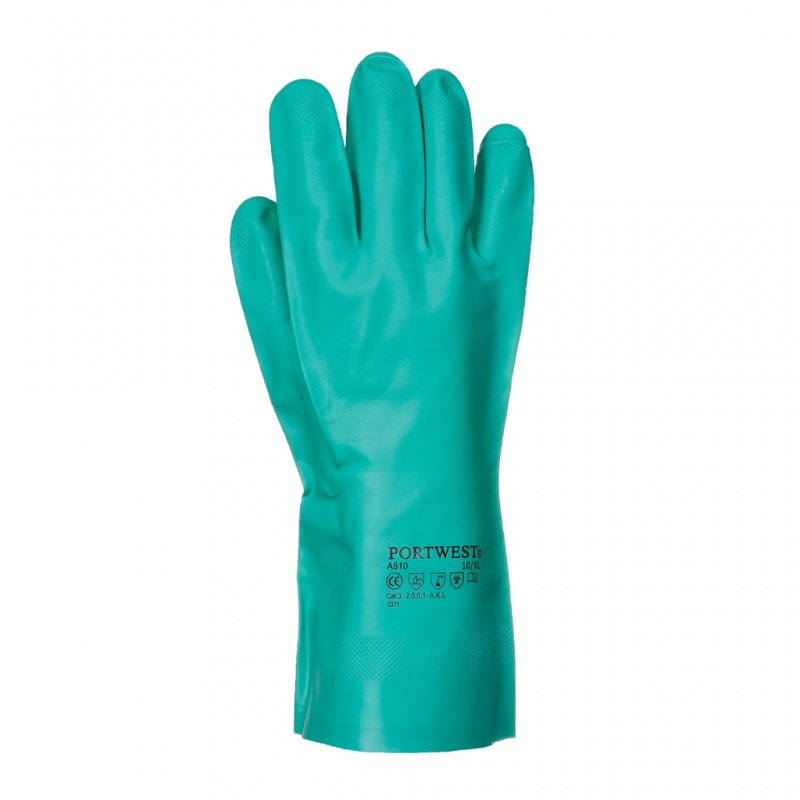
Reusable green nitrile glove with a flocked lining, 33 cm long and with an anti-slip pattern on palm and fingers. Four sizes, S to XL.
The 0.38 mm is not a shortcoming: it is what lets you feel the frame you are holding.
01 · WHY NITRILE AND NOT LEATHER
A leather glove absorbs everything it touches — syrup, honey, propolis, venom — and in time goes stiff and smells. Nitrile has a closed surface: rinse it under the tap and it is as new, and it does not carry from one hive to the next what it soaked up at the last. At 0.38 mm it is thin for a work glove, and that gives real feel in the fingers: you sense the frame, the clip, the queen. The flocked lining is what lets you pull it on and off with a dry hand, without the struggle of smooth gloves. The trade-off, and it is worth knowing: nitrile does not breathe. On hot days the hand ends up soaked, so alternate and do not spend hours on end wearing them.
02 · THE SIZE
It is the most repeated question and it has a simple answer, because glove sizing is not arbitrary: the number is the palm circumference measured in inches. Take a tape, run it round your hand at the knuckles, excluding the thumb, and divide the centimetres by 2.54 — the rounded result is your number. For reference: S (7) ≈ 18 cm · M (8) ≈ 20 cm · L (9) ≈ 23 cm · XL (10) ≈ 25 cm. If you fall between two, go up a size: a tight glove pulls at the knuckles, splits there first, and with a flocked lining is hard to get on.
03 · THE CHEMICAL SIDE
The manufacturer's sheet classes it as a category III glove under EN 388, EN ISO 374-1 and EN ISO 374-5. It is worth understanding what that does and does not mean: those standards certify behaviour against the specific substances that were tested, at their concentration and for their time. They do not make it a universal glove. Before handling an acid, a disinfectant or a treatment, identify the substance, concentration, temperature and expected contact time and consult the glove's current table — which is particularly relevant with the acids used in beekeeping. And it offers no thermal protection: it is not for molten wax or hot surfaces.
04 · BEFORE YOU BUY
It is reusable, which is why it needs checking: look for cuts, punctures and hardened areas before every use — a perforated glove has stopped being a glove. Wash and dry it after working, especially if you have handled product. And an honest qualification: its closed surface is a useful barrier in routine handling, but it does not guarantee freedom from stings.
| ✓ FITS | Work with syrup, honey or propolis, and any job that calls for finger feel. |
| ✕ IT DOES NOT GIVE | Thermal protection, nor resistance to any chemical just for being certified. |
| ⚠ NO BREATHABILITY | In heat the hand soaks: alternate and do not wear them for hours. |
| LTA reference | GNVF0101 |
|---|---|
| Material | Green nitrile, flocked lining |
| Thickness | 0.38 mm |
| Length | 33 cm |
| Sizes | S (7) · M (8) · L (9) · XL (10) |
| Indicative equivalence | 7 ≈ 18 cm · 8 ≈ 20 cm · 9 ≈ 23 cm · 10 ≈ 25 cm palm circumference |
| Grip finish | Textured fingers and palm |
| Sheet certification | Category III · EN 388, EN ISO 374-1 and EN ISO 374-5 |
| Thermal protection | No |
Data sheet
1 file available

check_circle
check_circle