 Apipasta with vitamins 15kg
 Beecomplet® Spring 14Kg
 Beekeeper suit with round veil
 Oxalic acid 1kg
 Beeswax Foundation 5kg
 Fresh royal jelly 20g
 Classic honey jar 1kg comb-lines TO77 - Pack of 16 units
 Promotor L Apis 1 litre
- Out of stock

 Share in WhatsApp
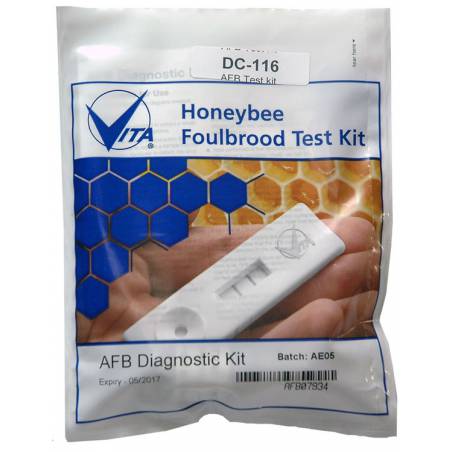
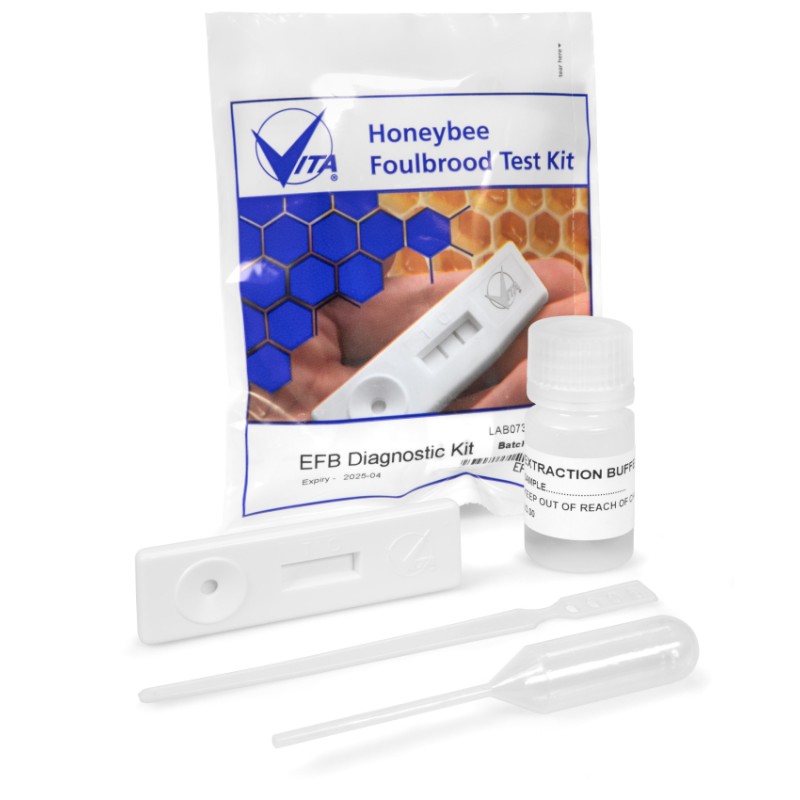
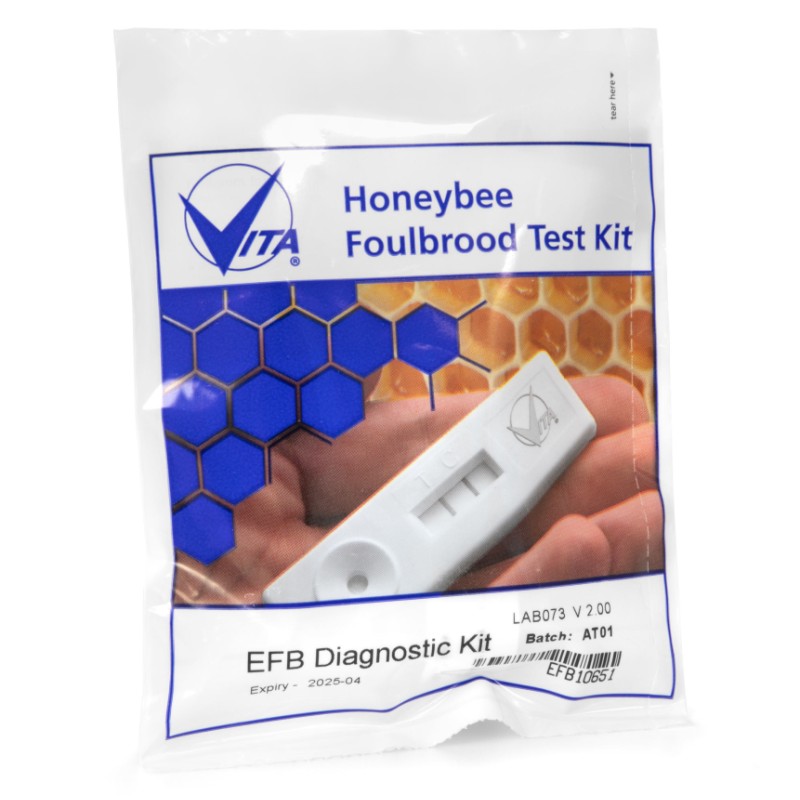
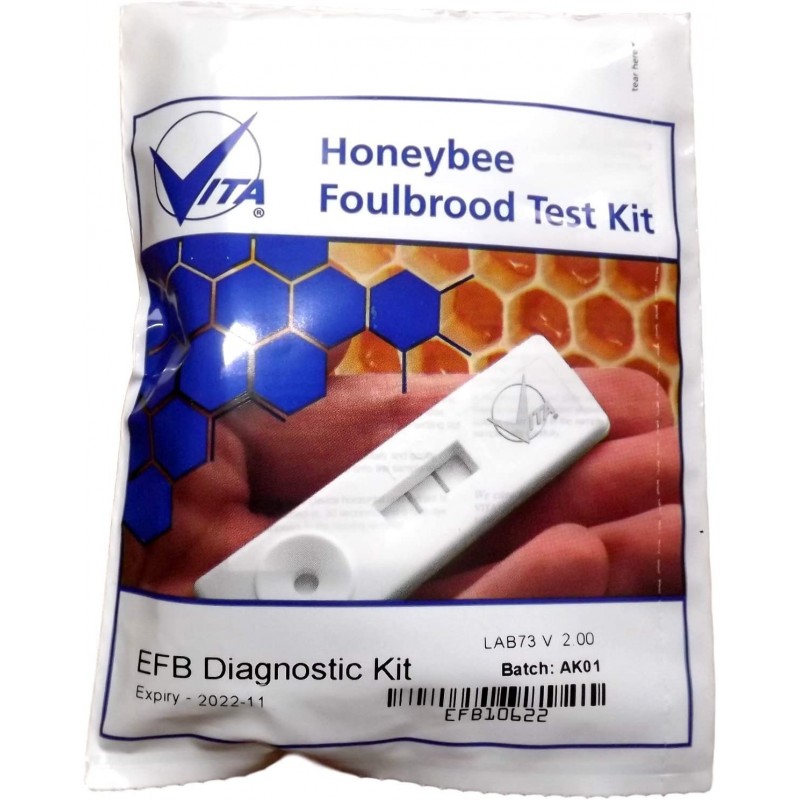
The foulbrood Diagnostic Test Kit enables to test for EFB in honeybee larvae and to obtain the results immediately and easily.
You sample a larva from an open cell. European foulbrood attacks unsealed brood, and that is the difference from the American one.
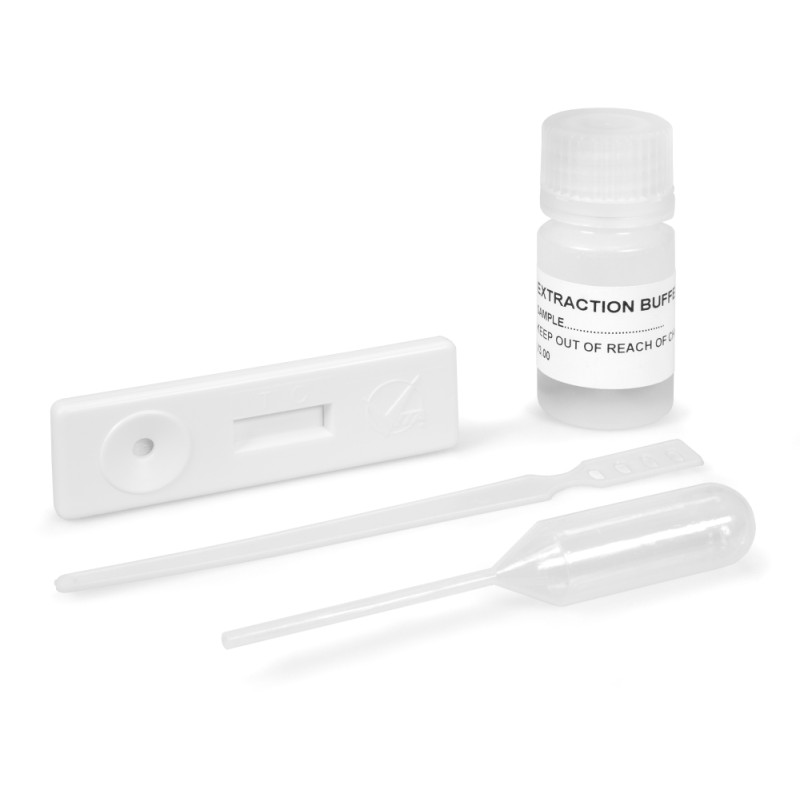
Rapid field test by Vita (Europe) to detect the agent of European foulbrood on a larval sample. Includes spatula, extraction bottle and pipette.
01 · WHICH LARVA TO TAKE
European foulbrood affects young brood, before capping. The suspect larva looks twisted in the cell, discoloured, as if it had collapsed into a posture that is not its own.
That is what separates this test from the American foulbrood one, which is sampled on already capped brood. Taking the wrong larva does not give a negative: it gives a result that means nothing.
02 · HOW IT IS DONE
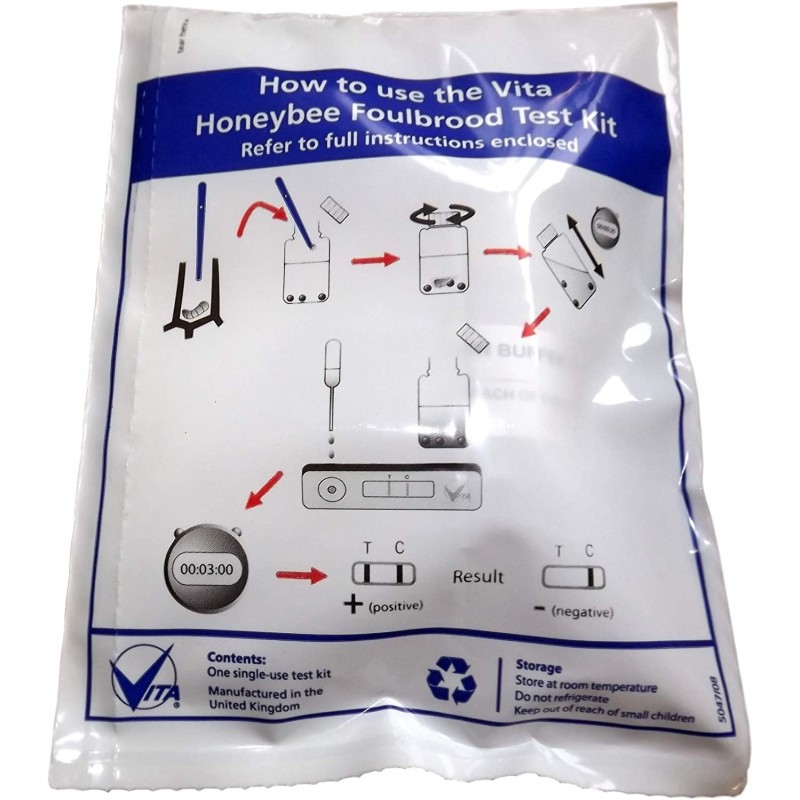
Lift the larva with the spatula and drop it into the bottle. The commonest error here is overdoing it: too much organic matter clogs the device. Very little is enough.
Close it and shake vigorously for about 20 seconds. Take the test out of its foil pouch without touching the viewing window, draw the sample with the pipette immediately after shaking — so the bacteria do not settle — and put two drops into the sample port.
Hold the device horizontal until it absorbs (about 30 seconds, a blue dye appears) and read between one and three minutes.
03 · HOW TO READ IT
This is the most misread part: not everything that is not two lines is a negative. Some combinations mean the test did not work and has to be repeated.
| What you see | What it means |
|---|---|
| Two blue lines (C and T) | Positive · the test worked |
| Only the C line | Negative · the test worked |
| Faint T, strong C | Possible positive · the test worked |
| Only the T line | The test failed |
| No lines at all | The test failed |
| Brown lines | The test failed |
Each device carries its batch number on the back, plus space to note the sample, the date and the result. If anything goes wrong, that number is what you quote.
04 · WHAT TO DO WITH A POSITIVE
A field test is a screening, not a diagnosis. A positive — and a faint T too — is reason to notify the official veterinary service, which is who confirms it and says what measures to take in the apiary.
And be clear before using it: this test authorises no treatment and does not replace an official diagnosis. What it does is give you, in three minutes and at the hive, a solid reason to call.
05 · PRECAUTIONS
The extraction bottle contains chemical buffer and sodium azide. Do not ingest it, do not touch the contents with bare hands and keep it out of the reach of children.
When you are done, the used material goes in the waste, not down the sink and not left in the field. It is a single-use kit and should be treated as one.
06 · BEFORE YOU BUY
A field screening, not a laboratory:
| ✓ FITS | Suspected European foulbrood on open brood, at the hive. |
| ✕ DOESN'T FIT | American foulbrood: different disease, different test. |
| ⚠ NOT INCLUDED | Gloves or a waste container. |
| Product | Rapid field test for European foulbrood |
|---|---|
| Brand | Vita (Europe) Limited |
| Sample | Larva from an open cell showing symptoms |
| Includes | Spatula, extraction bottle and pipette |
| Shaking | About 20 seconds |
| Reading | Between 1 and 3 minutes |
| Contains | Chemical buffer and sodium azide |
| Traceability | Batch number on the back of each device |
| Reference | TEBF001 |
The foulbrood Diagnostic Test Kit enables to test for EFB in honeybee larvae and to obtain the results immediately and easily.
check_circle
check_circle