 Apipasta with vitamins 15kg
 Beecomplet® Spring 14Kg
 Beekeeper suit with round veil
 Oxalic acid 1kg
 Beeswax Foundation 5kg
 Fresh royal jelly 20g
 Classic honey jar 1kg comb-lines TO77 - Pack of 16 units
 Promotor L Apis 1 litre

 Share in WhatsApp
380 mm LENGTH | 95 mm DEPTH |
116 mm HEIGHT | 2 SLIDE POSITIONS |
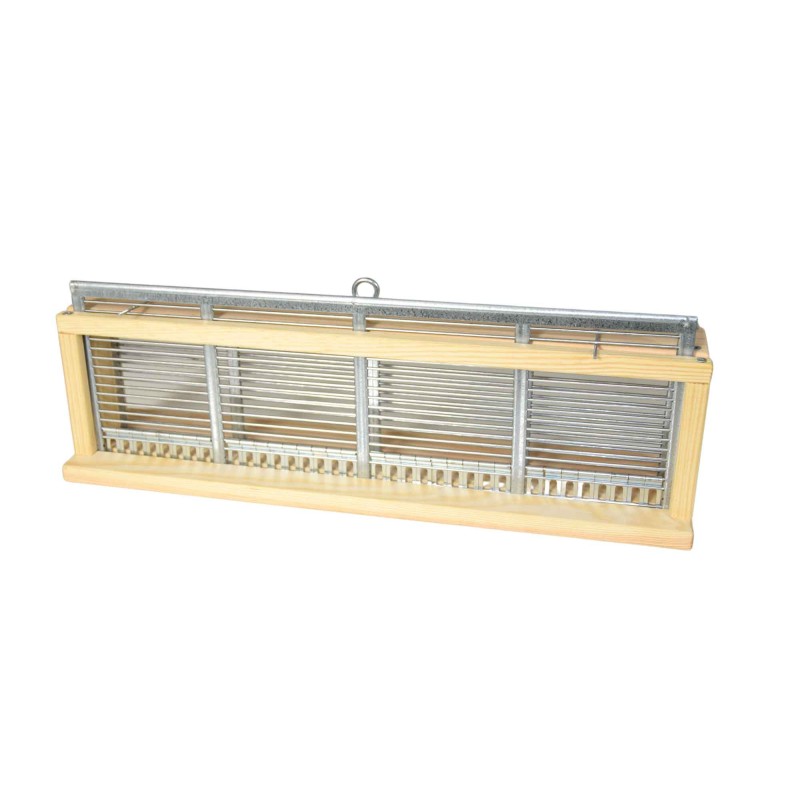
Wooden multi-catch device with a metal queen excluder, Ruck model 1902: it holds the queen and the drones in front of the hive entrance while the colony keeps flying.
It is not screwed to the hive and it does not close the entrance: it stands on the landing board, right in front of the entrance. Workers cross the excluder and keep flying in and out as usual; the queen and the drones cannot fit between the bars and stay inside the device.
01 · FITTING
This is the question that comes back from the apiary: the lower wooden rail is the foot the device rests on over the landing board, not a board that covers the entrance. You set it down with the grid face forward and the hive entrance opening into the inner volume. The maker puts it plainly: the traffic of the parent colony runs through the device and past the queen without being held up. Leave it in place the day before if you expect a swarm.
02 · MECHANISM
The front face is a flat queen excluder: the worker passes between the bars, the queen and the drone do not. Below it runs a row of hinged flaps that the queen pushes open on her way out and that fall shut behind her, so she traps herself with nobody standing in front of the hive. The drones build up in the compartments of the body.
03 · TAKING THE SWARM
With the queen inside you press the sheet-metal slide down as a second lock and hang the device from its central ring on a pole. Bring it close to the swarm and the bees cluster on it; the maker advises tying a leafy branch or a piece of bark to it first so they get a proper hold, then lowering the lot with the same pole. To give the queen back, lift the slide and let her run in.
04 · JUDGEMENT ON DRONES
With heavy drone traffic the device clogs: the maker asks you to check it on the first day during peak drone flight and again at dusk, both to keep it clear and to avoid leaving the trapped animals shut in and overheating. A healthy colony needs its share of drones, so trapping is for the excess and for genetics you do not want. The day before an expected swarm it does pay to take them out: they no longer block the way and the queen shows up in the cage at once.
05 · BEFORE YOU BUY
The entrance measurement decides, not the hive name: the device is 380 mm long and needs 95 mm of landing board to sit on, with the entrance running full width and clear.
| ✓ FITS | Langstroth and Dadant Blatt, Spanish or US format, with a full-width entrance of 376 to 380 mm of clear front and a landing board deep enough for the 95 mm of the device. |
| ✕ DOES NOT FIT | Layens and any hive with a short, round or notched entrance; the standard Layens entrance is around 100-150 mm. Not with an entrance reducer or a mouse guard fitted either. |
| Reference | HOLT-7442-BR-1902 |
|---|---|
| Maker | Bienen-Ruck (Germany), model 1902 |
| Dimensions | 380 × 95 × 116 mm (length × depth × height) |
| Entrance needed | full width, 376-380 mm of clear front |
| Body | wood |
| Front face | flat metal queen excluder |
| Queen trap | row of hinged flaps |
| Lock | sheet-metal slide, 2 positions |
| Hanging | central ring for a pole |
| Supplied | 1 unit |
Data sheet
check_circle
check_circle