 Apipasta with vitamins 15kg
 Beecomplet® Spring 14Kg
 Beekeeper suit with round veil
 Oxalic acid 1kg
 Beeswax Foundation 5kg
 Fresh royal jelly 20g
 Classic honey jar 1kg comb-lines TO77 - Pack of 16 units
 Promotor L Apis 1 litre

 Share in WhatsApp
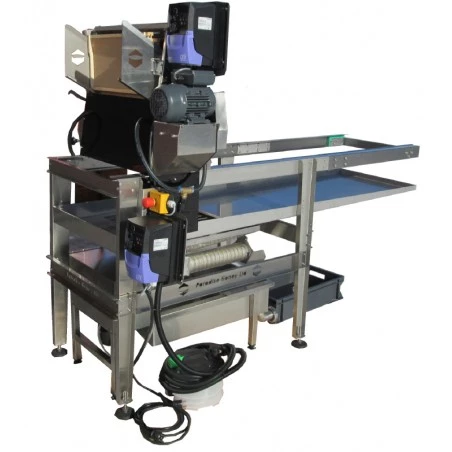
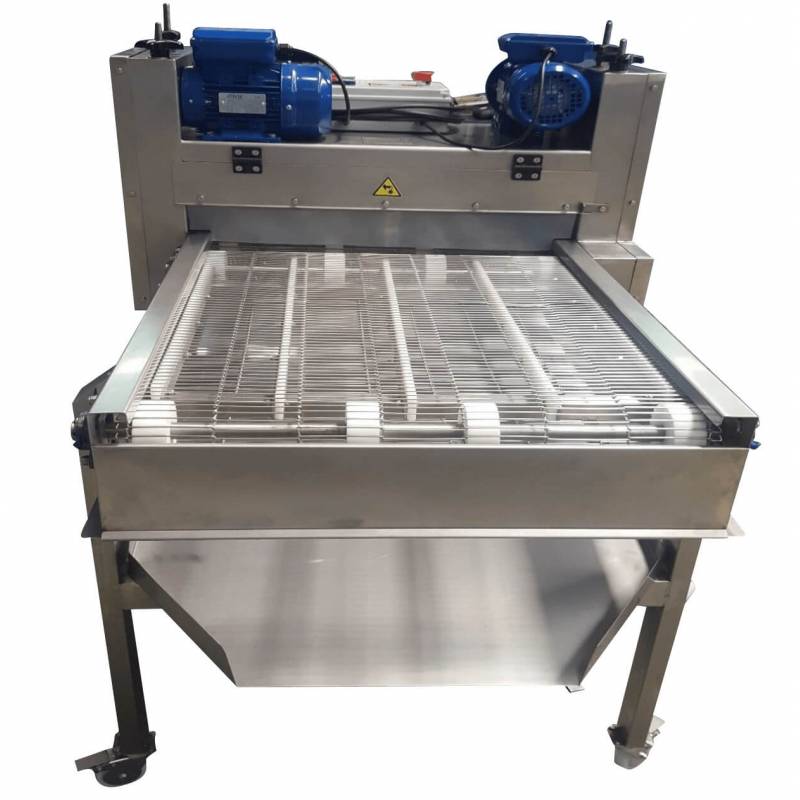
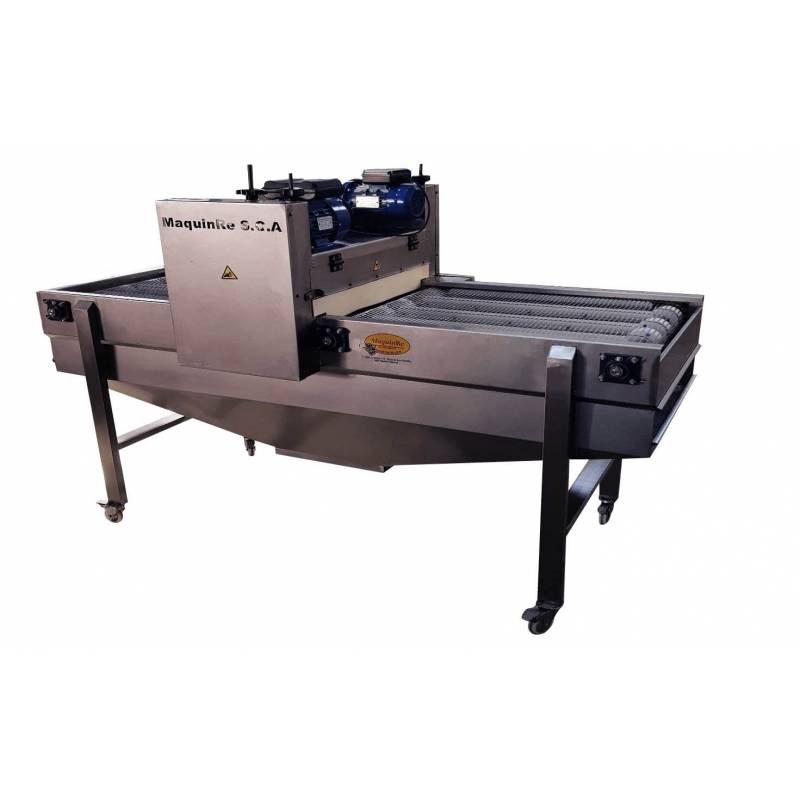
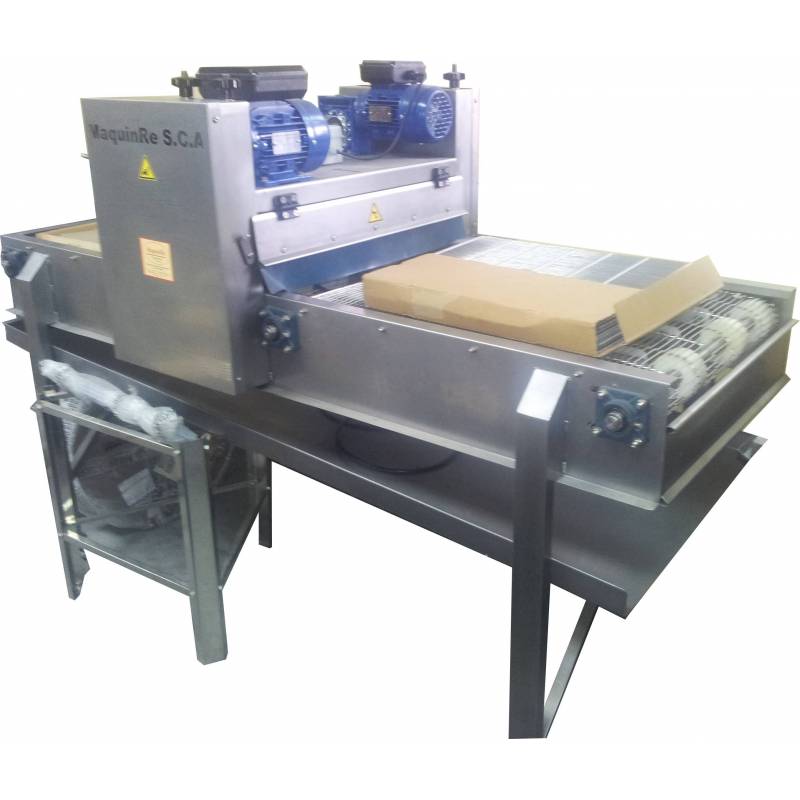
«Dakota» type rotary friction uncapper: the frame goes in on one conveyor and comes out uncapped on the other.
It is the uncapper that heats nothing. Two blade shafts — lower and upper — comb the cappings off continuously as the frame travels on a stainless modular belt. No heaters, no thermostat, no waiting for it to warm up: switch it on and it works. Takes Layens, Dadant, Langstroth and half-supers.
01 · NO HEATED BLADES
A heated-blade uncapper has to sit above the melting point of wax to cut cleanly, and from there it is a balancing act: go too far and you darken the cappings — first-quality wax — and heat the honey right at the cut surface.
Here that balance does not exist because there is no heat. The cut is mechanical: the shafts take the cappings off by friction. Neither the honey nor the wax meets a heat source at any point.
02 · 1.1 KW: A QUARTER OF A HEATED ONE
There are two single-phase motors: 1 hp for the blades and 0.5 hp for the conveyors. About 1.1 kW in total, which on 220 V is roughly 5 amps.
For comparison: a heated-blade uncapper asks for around 2.8 kW, and the heaters take almost all of it. This one fits comfortably in any honey-house installation without touching the board.
03 · THE FRAME HAS TO GO IN STRAIGHT
Friction machines run beautifully when frames go in straight, with well-drawn comb and no distortion. That is their operating condition, not a fault.
With badly bowed frames, slack wires or old comb that tears, you slow down and fine-tune the setting so as not to take off too much. And with very dense honey or hard cappings, keep the room at working temperature: you warm the air, not the honey, and that is what keeps the cut clean without touching the product.
04 · THE TRAY CLOSES THE CIRCUIT
Under the cutting zone there is a cappings collection tray, which is what makes the machine part of a line rather than a stand-alone device. From there you can couple a press, a melter or a spinner without having anything made to measure.
It runs on swivel castors with brakes, so it moves around the honey house without a struggle despite its 158 kg. Made in Spain, with two years' warranty.
05 · SIZE AND SPACE
This is line machinery: 1,900 mm long by 900 wide overall and 950 high, with a 600 mm conveyor. That length is what you need measured before buying, because it includes the infeed and the outfeed.
The 950 mm height leaves it at a comfortable working level for feeding frames upright, without bending your back for every one.
06 · BEFORE YOU BUY
Line machinery for a long season.
| ✓ A GOOD FIT | Layens, Dadant, Langstroth and half-supers, with straight frames and well-drawn comb. |
| ⚠ IT NEEDS 1.9 M OF LENGTH | Infeed and outfeed included. Measure the space in your honey house before ordering. |
| ✕ NOT FOR BOWED FRAMES | With slack wire or old comb that tears you have to slow down. Friction wants a sound frame. |
| System | Rotary friction, two blade shafts |
|---|---|
| Heating | None: mechanical cold cut |
| Conveyors | Infeed and outfeed, stainless modular belt |
| Frames | Layens, Dadant, Langstroth and half-supers |
| Blade motor | 1 hp, single phase |
| Conveyor gearmotor | 0.5 hp, single phase |
| Approximate total draw | About 1.1 kW (~5 A at 220 V) |
| Collection | Cappings tray, couples to press or melter |
| Mobility | Swivel castors with brakes |
| Dimensions | 1,900 × 900 × 950 mm (L × W × H) |
| Conveyor width | 600 mm |
| Weight | 158 kg |
| Made in | Spain |
| Warranty | 2 years |
| Reference | 050906 |
Write your question
check_circle
check_circle