 Apipasta with vitamins 15kg
 Beecomplet® Spring 14Kg
 Beekeeper suit with round veil
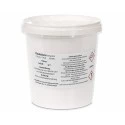 Oxalic acid 1kg
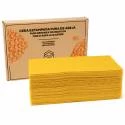 Beeswax Foundation 5kg
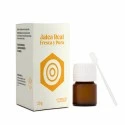 Fresh royal jelly 20g
 Classic honey jar 1kg comb-lines TO77 - Pack of 16 units
 Promotor L Apis 1 litre

 Share in WhatsApp
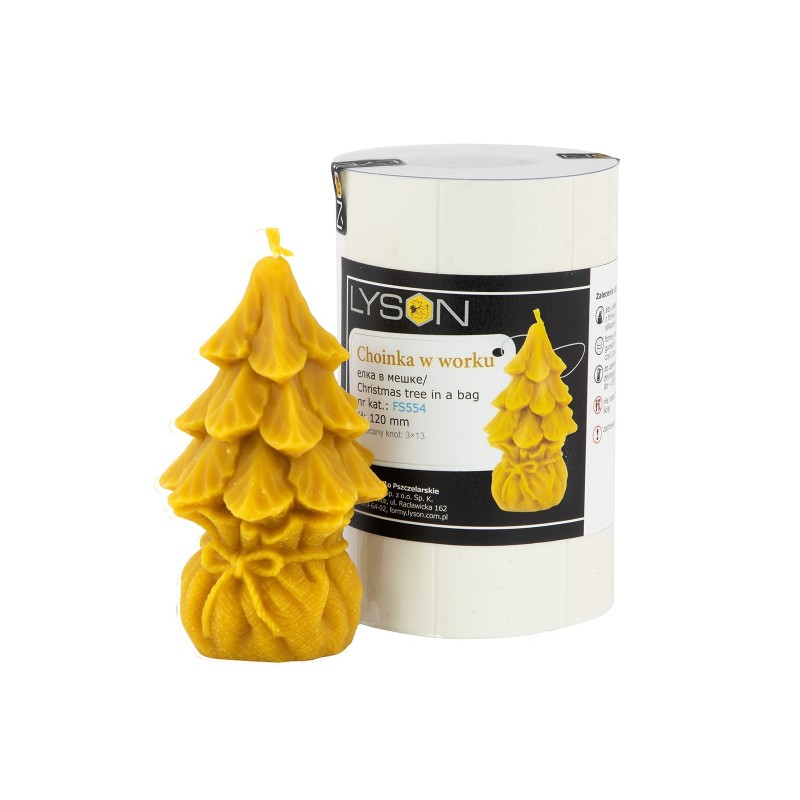
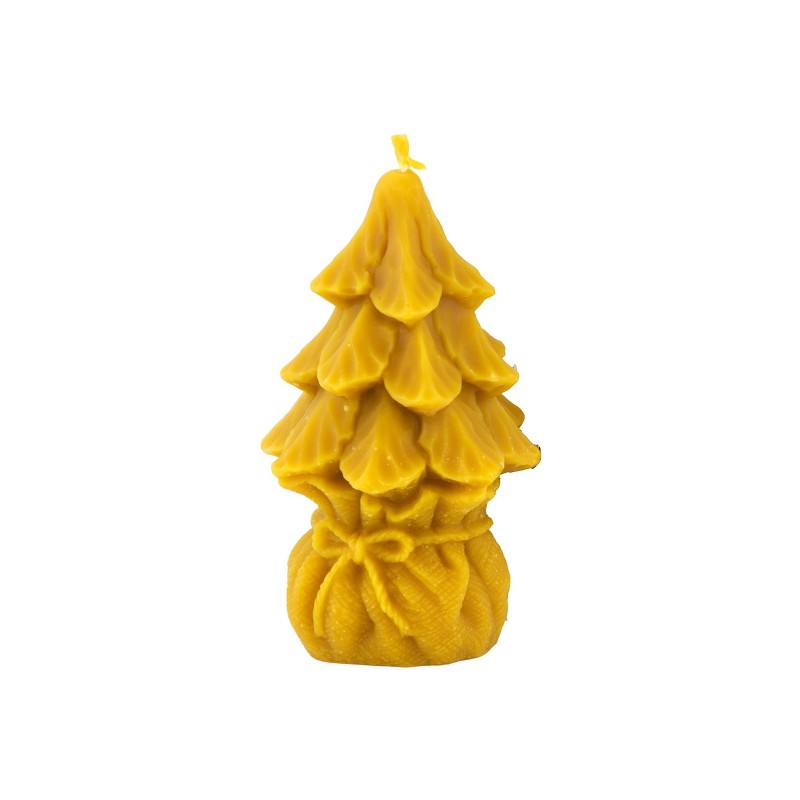
This charming silicone mould allows you to create a beeswax candle shaped like a Christmas tree wrapped in a decorative sack—perfect for the festive season or as a unique handcrafted gift.
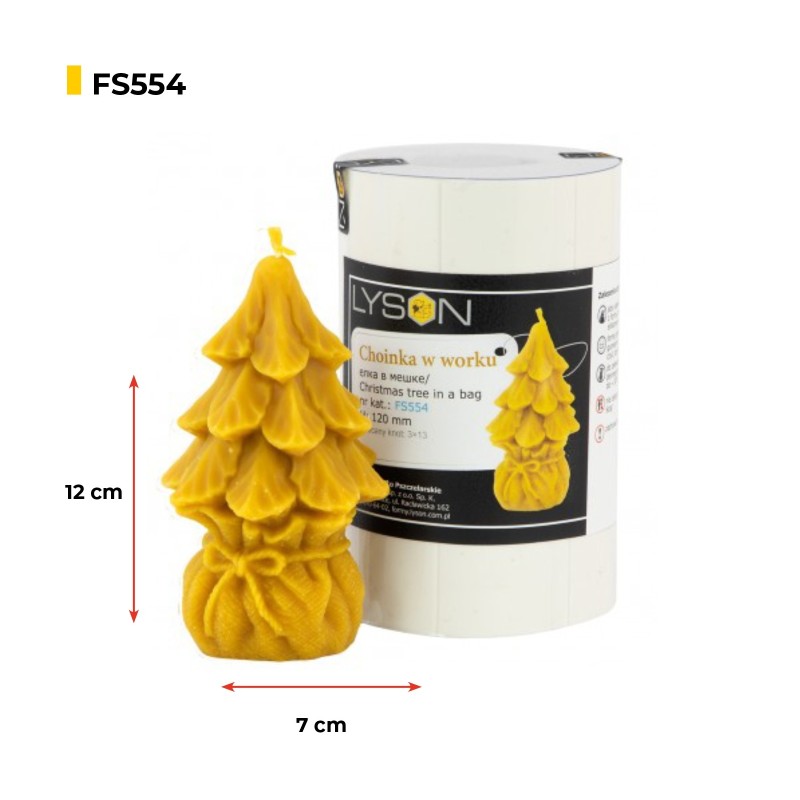
Silicone mould for a Christmas tree candle tucked inside a sack, 12 cm tall by 7 cm wide.
About 148 grams of wax per piece, according to LYSON: nearly seven candles to the kilo. That is the number a beekeeper turning cappings wax into Christmas stock actually wants, because it is the one that says how many pieces come out of the season. The working is below, so you can redo it with any other mould.
01 · THE WAX ARITHMETIC
The figure is 12 cm tall by 7 cm wide. The cylinder that wraps it, Ø 7 × 12 cm, holds 462 cm³, which at the density of beeswax (0.96 g/cm³) is 443 grams. That is a hard upper limit: no figure fills its own cylinder, and this one less than most, because the tree narrows as it rises.
LYSON puts this figure at around 148 grams. Weigh your first candle and adjust the number to your own wax: it takes a minute and settles your yield for good.
02 · THE WICK, AS A STARTING POINT
The maker recommends a 3×13 wick for this figure. Take it as a starting point rather than a guarantee, because beeswax melts higher than paraffin and asks for more wick at the same diameter.
The sign is easy to read: if the first candle digs a well and the flame drowns inside it, the wick was too small and you go up a size. If the pool floods over the edge, there is too much wick.
03 · HOW TO POUR IT
The mould has to be clean and completely dry. Centre the wick, secure it and pour the molten wax at around 70-75 °C: above 85 °C beeswax starts to darken and you lose exactly the colour that makes a beeswax candle worth having. The mould has a slit: before pouring, close it with rubber bands so the wax does not escape through the join.
Then cool at room temperature without moving the mould, which is what prevents cracks and internal voids. It comes out whole thanks to the flexibility of the silicone; trim the wick to 5-10 mm and fine flashing comes away with a thin blade or with warm fingers.
04 · WHY THIS FIGURE
Cappings wax is the worst exploited by-product of the harvest: it is sold in bulk by the kilo when it could be sold by the piece. A seasonal figure like this one multiplies the value of that same kilo, and it is beeswax, with no dyes and no added fragrance, which is what people buying handmade look for.
05 · BEFORE YOU BUY
A wax mould is not a kitchen mould.
| ✓ FITS | Beeswax for figures of 12 × 7 cm, at around 148 g a piece and a 3×13 wick as a starting point. |
| ⚠ WEIGH THE FIRST ONE | The wax figure is the LYSON catalogue value and is approximate. Your first piece gives you the exact number for your own wax. |
| ✕ NOT FOR FOOD USE | This is a mould for wax. Do not use it for food, silicone or not. |
| Model | FS554 |
|---|---|
| Figure | Christmas tree in a sack, 12 cm tall × 7 cm wide |
| Mould | 13.5 cm tall × Ø 8.5 cm; perimeter 26.5 cm |
| Material | Flexible heat-resistant silicone |
| Wax per piece | Around 148 g, per LYSON (nearly 7 candles per kilo) |
| Recommended wick | 3×13, as a starting point |
| Pouring temperature | 70-75 °C |
| Release | Mould with a slit: closed with rubber bands, opened when the piece is cold |
| Reference | FS554 |
Data sheet
Specific References
This charming silicone mould allows you to create a beeswax candle shaped like a Christmas tree wrapped in a decorative sack—perfect for the festive season or as a unique handcrafted gift.
check_circle
check_circle