 Apipasta with vitamins 15kg
 Beecomplet® Spring 14Kg
 Beekeeper suit with round veil
 Oxalic acid 1kg
 Beeswax Foundation 5kg
 Fresh royal jelly 20g
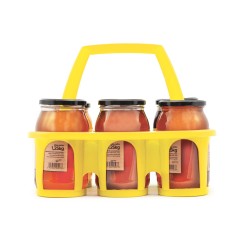
 Classic honey jar 1kg comb-lines TO77 - Pack of 16 units
 Promotor L Apis 1 litre

 Share in WhatsApp
It goes on last, once the jar is full and closed. And from then on, that jar cannot be opened without it showing.
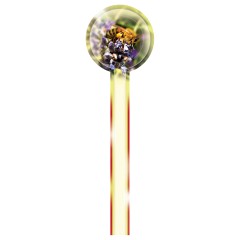
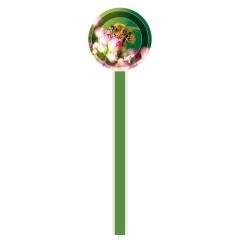
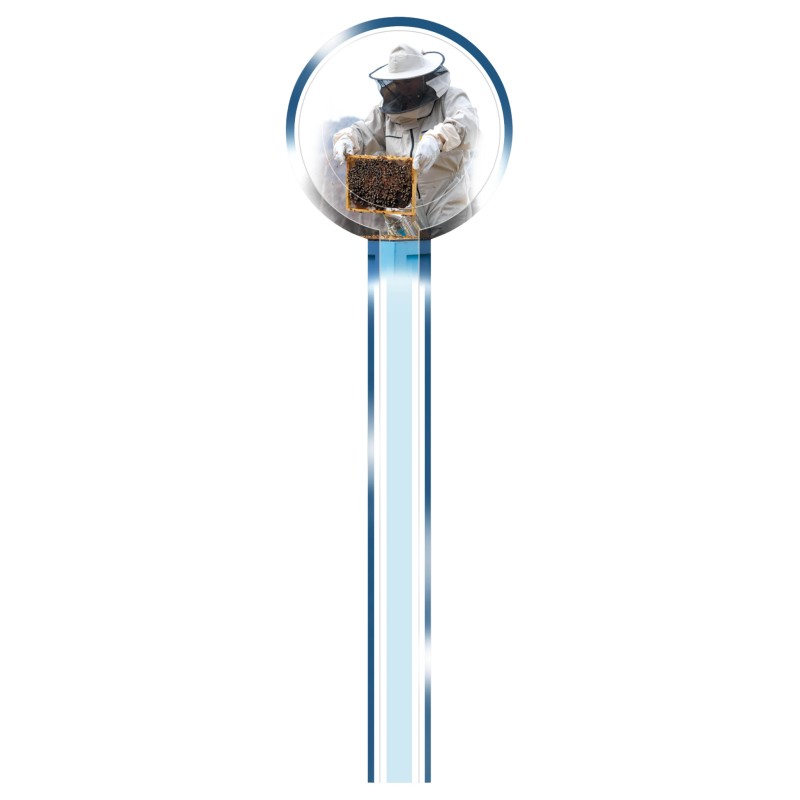
Pack of 100 self-adhesive seals of 41 × 145 mm showing a beekeeper inspecting a frame. Applied by hand over the lid and the sides.
01 · WHAT THE IMAGE SAYS
The drawing is a beekeeper mid-inspection, frame in hand. To someone buying at a market it says something very specific: that behind the jar there is a person who opens hives, not a brand that buys in bulk.
It works well on own-harvest honeys and on batches you want to set apart. If you would rather the image spoke of the flower and not the trade, we have the same format with other motifs.
02 · WHAT SEALING MEANS
The seal crosses the lid and runs down both sides, so opening the jar breaks it. That is what the customer buys: the certainty that nobody opened it before.
And from that comes a practical consequence: if you sell at a fair and people want to smell or taste, you need a separate sample jar. A sealed jar you open in front of a buyer is no longer sealed.
03 · APPLYING IT
Peel and place, with no machine and no heat. The one non-negotiable is that the lid is clean and dry: a trace of honey on the rim lifts the seal within two days.
At 145 mm long, what runs down each side is what is left after crossing the lid. Do the subtraction with your own diameter before ordering a hundred.
04 · BEFORE YOU BUY
A hundred seals, and nothing else:
| ✓ FITS | Own-harvest honey in direct sales, markets and shops. |
| ✕ DOESN'T FIT | Replacing mandatory labelling: this is not a label. |
| ⚠ NOT INCLUDED | Product labels or jars. |
| Product | Self-adhesive lid seal |
|---|---|
| Design | Beekeeper inspecting a frame |
| Format | Pack of 100 units |
| Dimensions | 41 × 145 mm |
| Application | By hand, over lid and jar sides |
| Reference | BAES201 |
check_circle
check_circle