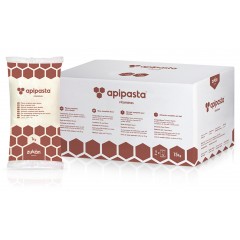
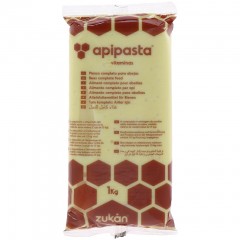
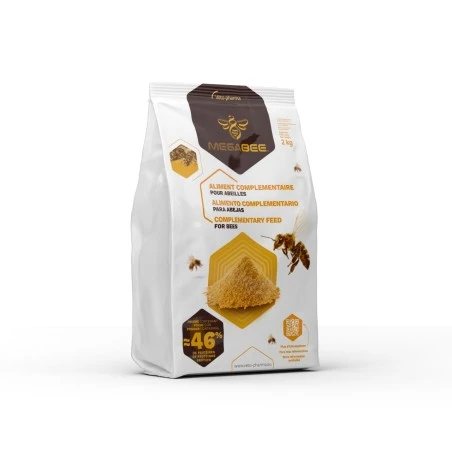
 Apipasta with vitamins 15kg
 Beecomplet® Spring 14Kg
 Beekeeper suit with round veil
 Oxalic acid 1kg
 Beeswax Foundation 5kg
 Fresh royal jelly 20g
 Classic honey jar 1kg comb-lines TO77 - Pack of 16 units
 Promotor L Apis 1 litre


 Share in WhatsApp
11 % CRUDE PROTEIN | 300 g SINGLE PATTY |
2-4 WEEKS BEFORE THE FLOW | < 20 °C STORAGE TEMPERATURE |
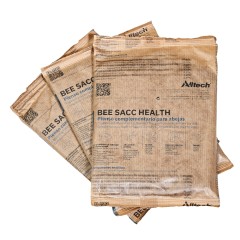
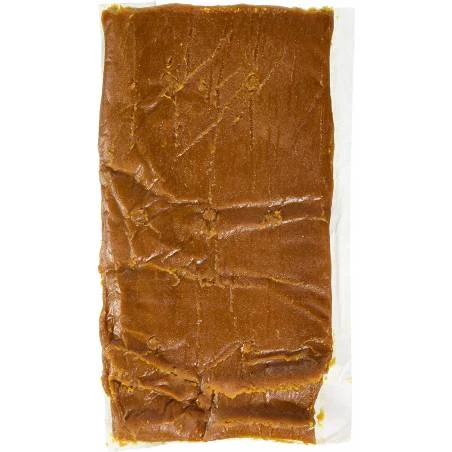
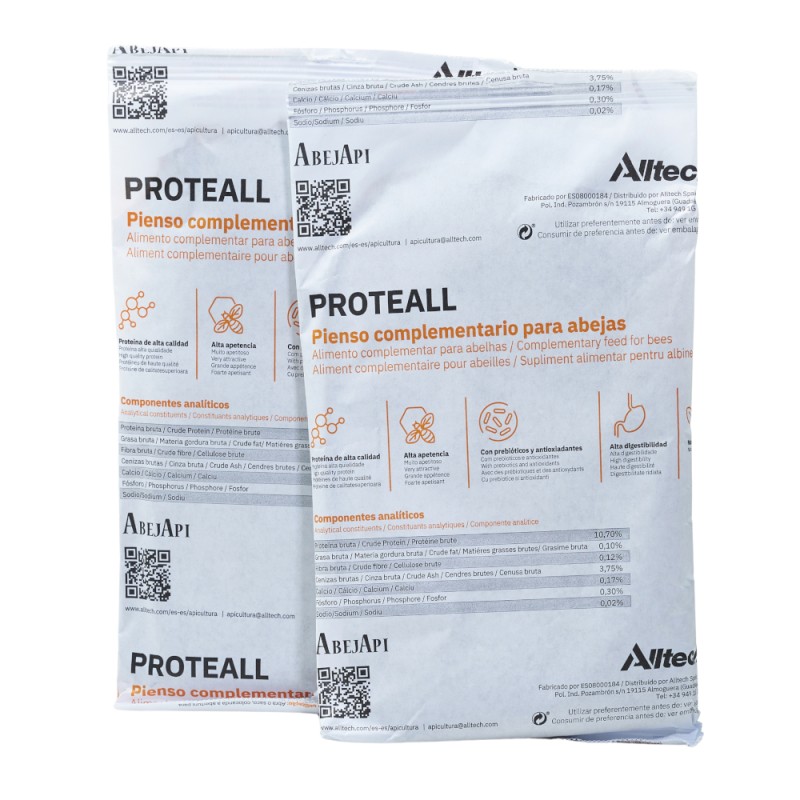
Soft 300 g patty ready to lay over the frames, with sugars, yeast products and 11 % crude protein; allow one per hive a week while the dearth lasts and the queen is laying, topping up as soon as little more than the paper is left.
Ready to use: no syrup to mix and no feeder to clean. If no nectar is coming in and the hive is short of honey, give a little light syrup alongside it: with nothing sweet in the hive, the bees strip the sugar out of the patty and dump the rest. It is a complementary feed with 11 % crude protein: it backs up field pollen when it runs short, it does not replace it.
01 · WHY PROTEIN
From the amino acids in its diet the bee builds the antimicrobial peptides that pass into its haemolymph and into the royal jelly it feeds to young larvae and to the queen: those are its immune system. And they come almost only from pollen, which needs four or five different flowerings to be complete. When the field does not provide them, a protein feed covers the gap. It cures nothing: it keeps the raw material from running out.
02 · WHAT IT GIVES
The base is sugars — beet sugar, dextrose and fructose — with yeast products (Saccharomyces cerevisiae) providing the protein and prebiotic fraction, plus zinc, selenium and vitamin C. To build up colonies of the Iberian bee, the good-practice manual by Pajuelo Consultores (Spain) recommends a patty of around 10 % protein: with higher percentages, this bee may be slow to take it. At 11 % crude protein, this patty is in that line.
03 · WHEN TO GIVE IT
Where it shows: two to four weeks before a flow to stimulate laying, as the manufacturer indicates (if what you want is foragers on that flow, start earlier: about six weeks, two brood cycles), and always while no pollen is coming in from the field; in confinement and transport — where stress is paid for in stores —, on nucs and queen rearing batches just made up, and after glasshouse pollination. And in autumn, while the queen is still laying and no pollen is coming in: the winter bees build their reserves on the pollen of those weeks, and once the cluster has formed it is too late. In monoculture areas it covers the gap between flows. What it does not do: it does not cure disease, it does not replace varroa control and it does not guarantee a crop.
04 · HOW TO PUT IT ON
Tear the paper and lay the patty opening down on the top bars of the brood frames, centred over the cluster and touching the bees; an empty super or the crown board is only there for headroom. On double brood, it goes between the two boxes, above the one with the brood. The cellulose paper itself acts as a base and keeps the patty from drying out; the bees work it from below. Store the ones you do not use below 20 °C, dry and out of direct sun.
⚠ PRECAUTIONS
Do not feed patties during a flow or with honey supers on: whatever goes into the super ends up in the honey you are going to jar. Take any remains out before supering.
05 · BEFORE YOU BUY
This reference is the single 300 g patty. The wrapper is biodegradable cellulose paper with no plastic, so it arrives soft to the touch: that is normal for a patty of this kind.
| ✓ FITS | Any hive: it sits on the top bars, no feeder needed. |
| ⚠ NOT INCLUDED | Winter stores. For those, heavy syrup or fondant separately. |
| Format | Soft 300 g patty, wrapped in biodegradable cellulose paper |
|---|---|
| Crude protein | 11.00 % |
| Composition | Beet sugar, dextrose, fructose and yeast products (Saccharomyces cerevisiae) |
| Other components | Crude fat 0.10 % · crude fibre 0.12 % · crude ash 3.75 % · calcium 0.17 % · phosphorus 0.30 % · sodium 0.02 % |
| Trace elements and vitamins | Chelated zinc 75 mg/kg · selenium from selenised yeast 0.02 mg/kg · vitamin C 210 mg/kg |
| Preservative | Potassium sorbate |
| Storage | Cool, dry place below 20 °C, out of direct sun |
| Packing | Boxes of 30 patties (9 kg) |
1 file available