 Apipasta with vitamins 15kg
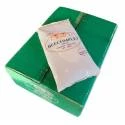 Beecomplet® Spring 14Kg
 Beekeeper suit with round veil
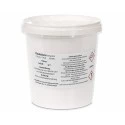 Oxalic acid 1kg
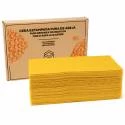 Beeswax Foundation 5kg
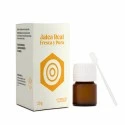 Fresh royal jelly 20g
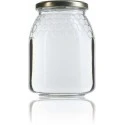 Classic honey jar 1kg comb-lines TO77 - Pack of 16 units
 Promotor L Apis 1 litre

 Share in WhatsApp
900 g GLASS JAR | Pale amber FLORAL AND FRUITY, SUBTLY BITTER |
Alicante THE MARINA BAJA DISTRICT | Unpasteurised BOTTLED RAW; CRYSTALLISES FAST |
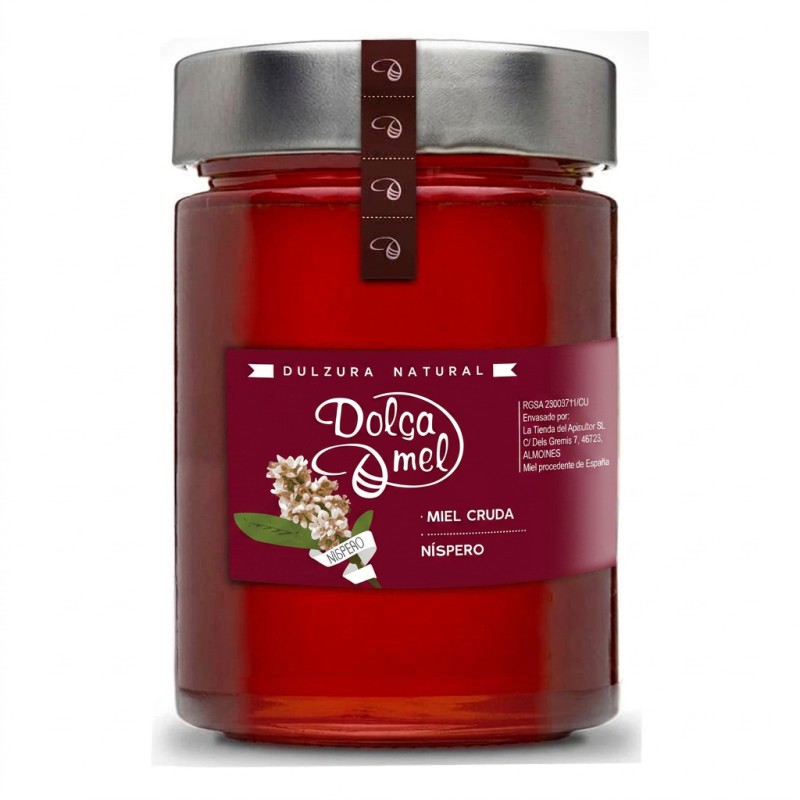
Loquat honey in a 900 g jar, harvested in the apiaries of the Marina Baja in Alicante, loquat country (Eriobotrya japonica). Pale amber, a floral and fruity aroma recalling the fruit itself, sweetness with a bitter, astringent edge, and fast crystallisation. Bottled unpasteurised.
It is a one-district honey: it comes only from the loquat orchards there, which is why there is little of it and it tastes different.
01 · SENSORY PROFILE
Pale amber, the range of Rosaceae honeys. The aroma is floral with fruity notes recalling the loquat: stone fruit, ripe apple, a soft base of bitter almond. On the palate it is sweet with a subtle bitterness and a light astringency that leaves the mouth clean: the variety’s signature, what separates it from a sugary orange-blossom or rosemary. It crystallises fast because of its glucose; within a few weeks it turns creamy or grainy, often coarse-grained.
02 · ORIGIN
The Japanese loquat reached the Mediterranean in the 19th century. This honey comes from the loquat orchards of Callosa d’en Sarrià and the Marina Baja, in Alicante. Production is small and depends on the year. The packer declares it monofloral.
03 · WHAT RAW MEANS
“Raw” is the trade name of the range: honey bottled unpasteurised, so the fruity aroma, the first thing heat destroys, reaches the jar. Directive 2001/110/EC, in Spain Royal Decree 1049/2003, sets what betrays heat and age: HMF below 40 mg/kg and diastase of at least 8 Schade units; in a flower honey, conductivity stays below 0.8 mS/cm. Each lot’s values go in its quality sheet, not on this page.
04 · AT THE TABLE
Its fruity profile with a bitter edge goes with plain yoghurt and curd, fresh cheeses (requesón, mató, ricotta), toasted almond and walnut, sponge cakes and muffins, and delicate infusions: chamomile, lime blossom, rooibos. Alone, by the spoon, it does not cloy. If it crystallises and you want it liquid, a gentle water bath not above 40 °C, stirring; never the microwave. Keep closed, cool and dry, no fridge. It is a food, not a treatment, and is not given to children under 12 months.
05 · BEFORE YOU BUY
One 900 g glass jar is supplied; the rest of the raw range (orange blossom, lemon, wildflower, forest) has its own pages.
| ✓ FITS | Anyone after a rare honey, fruity and with a subtle bitterness, for yoghurt, fresh cheeses and baking. |
| ✕ DOESN’T FIT | Anyone wanting a honey that stays liquid for months: this one crystallises fast, and that is normal. |
| ⚠ NOT INCLUDED | Lot quality sheet: analytical values are published per lot, not here. |
| Reference | MIEL-NSP-900 |
|---|---|
| Trade name | Raw loquat honey |
| Ingredient | Honey |
| Botanical origin | Japanese loquat (Eriobotrya japonica); monofloral according to the packer |
| Geographical origin | Spain: Marina Baja (Alicante) |
| Use | Yoghurt, fresh cheeses and baking |
| Net quantity | 900 g, glass jar |
| Profile | Pale amber; floral and fruity; sweet with subtle bitterness and light astringency |
| Crystallisation | Fast; medium to coarse grain |
| Treatment | Unpasteurised |
| Regulation | Directive 2001/110/EC; Royal Decree 1049/2003 |
| Storage | Cool, dry place, jar closed, no fridge |
| Warning | Not suitable for children under 12 months |

Write your question
check_circle
check_circle