 Apipasta with vitamins 15kg
 Beecomplet® Spring 14Kg
 Beekeeper suit with round veil
 Oxalic acid 1kg
 Beeswax Foundation 5kg
 Fresh royal jelly 20g
 Classic honey jar 1kg comb-lines TO77 - Pack of 16 units
 Promotor L Apis 1 litre

 Share in WhatsApp
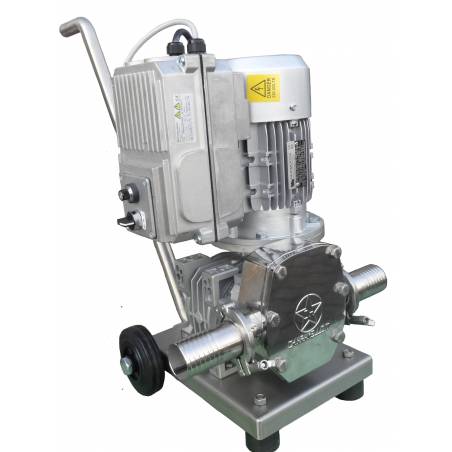
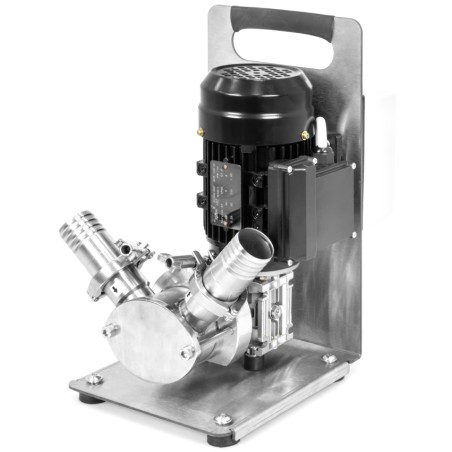
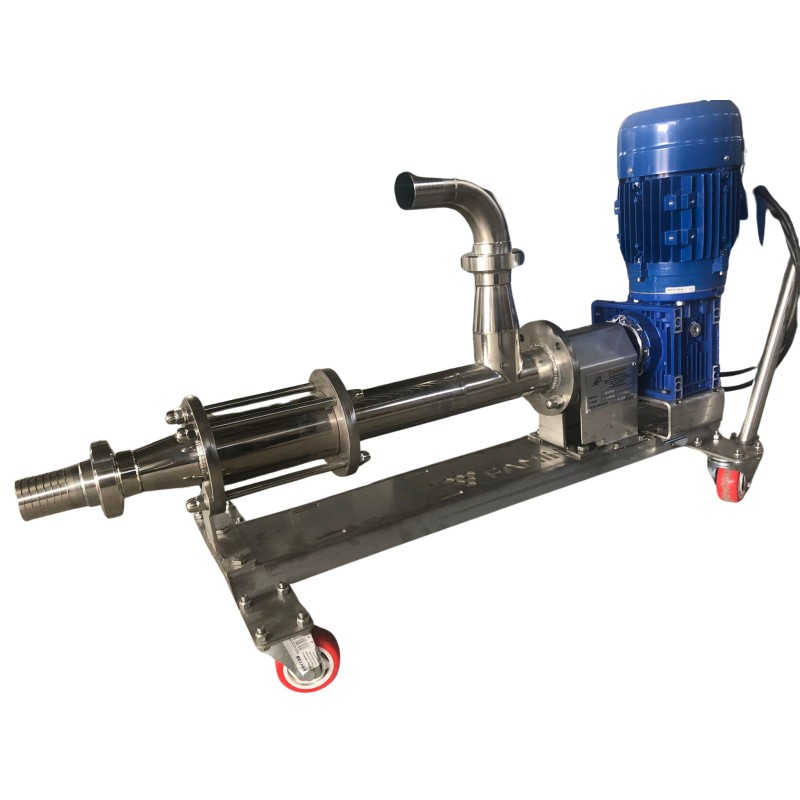
The Progressive Cavity Pump is an advanced solution specifically designed for honey transfer, including honey containing particles of cappings. This type of pump, also known as an eccentric rotor pump, differs from other pumping systems in its ability to handle highly viscous fluids and solids without compromising product quality.
Progressive cavity pump with inverter: constant flow even when the honey is cold, and it takes 5-6 cm cappings without jamming.
Every turn moves a fixed volume. Everything else follows from that. A metal screw rotor turns inside a rubber stator, pushing closed cavities of honey along. The flow does not depend on viscosity as it does on an impeller: with cold holm-oak honey at 20 °C it still delivers the same, with no pulses, no air and no whipping.
01 · WHY NOT AN IMPELLER PUMP
On an impeller pump the flow drops as soon as the honey thickens, and the line fills with bubbles exactly when you least want it. Here the displacement is positive: every turn moves the same volume, so the flow is linear and predictable.
That is what lets it feed equipment that demands a constant rate — a cappings centrifuge asks for something like 200-270 g/s — and move forest, heather or holm-oak honey as smoothly as a rosemary. And it carries 5 or 6 cm cappings in the mix without flinching.
02 · SELF-PRIMING AND REVERSIBLE
It needs no priming: it draws from the first turn. And the Invertek inverter reverses the direction, which is what solves emptying a line, clearing a blockage or purging in seconds instead of dismantling hoses.
With properly sized hose it lifts 8 to 10 metres and pushes through 30 or 40 metres of pipe, so the room is laid out as suits you and not as gravity dictates. Speed is set from 0 to 600 rpm, with overload protection.
03 · NEVER DRY
This pump is lubricated by the honey itself. Run empty, the rotor rubbing on the rubber burns the stator in a matter of minutes, and that is the consumable of the machine: it lasts in the order of 1,000 to 2,000 hours of normal work.
That is why two accessories are not optional in practice: a bypass valve set at 3-4 bar and, better still, a minimum-level probe that cuts the inverter when the tank empties. Neither is included.
04 · MAINTENANCE AND MATERIALS
When you finish, circulate water at 40-50 °C for two or three minutes in both directions and leave the pump empty. The rotor lasts in the order of 3,000 to 4,000 hours unless it is worked continuously on crystallised honey.
Everything touching the honey is AISI 316L stainless steel, the stator is food-grade NBR and the seals are FPM. It is mounted on a stainless trolley with wheels, two of them braked.
05 · BEFORE YOU BUY
A volume machine, with two accessories to add.
| ✓ FITS | Transfers above 2,000 kg a year, viscous honeys and feeding filters, exchangers or centrifuges. DN50 connections. |
| ⚠ NOT INCLUDED | The safety bypass valve, the hoses and Camlock or DIN fittings, and the recommended minimum-level probe. |
| ✕ NOT FOR SMALL VOLUMES | Below 1,000 kg a year, or for short transfers between tanks, an impeller pump does the job and costs far less. |
| Type | Progressive cavity pump with inverter |
|---|---|
| Flow | Up to 5,000 L/h on water; on dense honey, in the order of 1,000-1,500 kg/h depending on temperature |
| Maximum pressure | 12 bar in two stages (around 6 bar single) |
| Speed | 0 to 600 rpm, with reverse |
| Lift | 8-10 m, and push through 30-40 m of pipe |
| Working range | -10 °C to +85 °C; for honey, the low end of the band |
| Solids accepted | Cappings of 5-6 cm |
| Connections | DN50, Camlock or DIN compatible |
| Materials | AISI 316L in contact with honey · food-grade NBR stator · FPM seals |
| Supply | 230 V or 380 V, controlled by an Invertek inverter |
| Mounting | Stainless steel trolley with wheels, two braked |
| Consumables | Stator: 1,000-2,000 h · rotor: 3,000-4,000 h |
| Includes | Pump on trolley, motor with reducer, inverter with control panel and manual |
| Reference | D3013-0100 |
Data sheet
The Progressive Cavity Pump is an advanced solution specifically designed for honey transfer, including honey containing particles of cappings. This type of pump, also known as an eccentric rotor pump, differs from other pumping systems in its ability to handle highly viscous fluids and solids without compromising product quality.
check_circle
check_circle