 Apipasta with vitamins 15kg
 Beecomplet® Spring 14Kg
 Beekeeper suit with round veil
 Oxalic acid 1kg
 Beeswax Foundation 5kg
 Fresh royal jelly 20g
 Classic honey jar 1kg comb-lines TO77 - Pack of 16 units
 Promotor L Apis 1 litre

 Share in WhatsApp
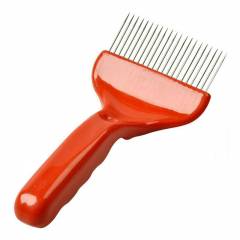
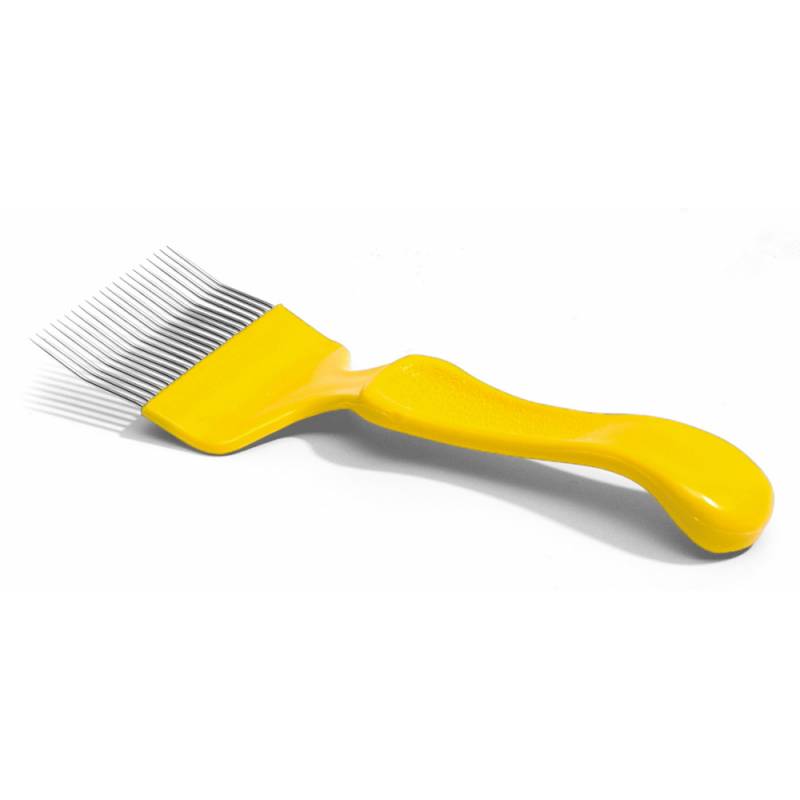
The fork that reaches where the knife cannot: sunken cells and uneven combs.
Fine tines on a handle: they lift the capping without tearing wax off the comb. It is the finishing tool of uncapping, not the one for the first pass.
01 · WHEN TO USE IT
The knife uncaps 90 % of the frame in two passes, and the rest always remains: the cells sunk below the frame, the corners, the comb the colony drew crooked. That is where the fork comes in. It is also what you use when the frame holds little honey and heating the knife is not worth it, or when you are working a few frames and do not want to set up the whole bench.
02 · HOW TO USE IT
Rest it almost parallel to the comb, sink the tines just enough to catch the capping and pull upwards in one continuous motion. Stab it in perpendicular and lever, and you tear off good wax and bend a tine — that is the only way to ruin it. When you finish, hot water to release the wax, then dry it: honey dried between the tines is far harder to shift the next day.
03 · BEFORE YOU BUY
There are two models, curved tines and straight tines; it is a matter of which suits your hand. And if you uncap frames by the dozen, this is the complement: the first pass belongs to a knife or an uncapping machine.
| ✓ GOOD FOR | Any frame and size: Layens, Langstroth, Dadant and shallows. |
| ⚠ BEAR IN MIND | It is a finishing tool: for large batches, use a knife or an uncapper. |
| LTA reference | 060104 |
|---|---|
| Type | Uncapping fork |
| Models | Curved or straight tines |
| Use | Finishing sunken cells, corners and uneven combs |
| Cleaning | Hot water when you finish, then dry |
Data sheet

check_circle
check_circle