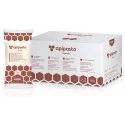
 Apipasta with vitamins 15kg
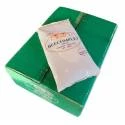 Beecomplet® Spring 14Kg
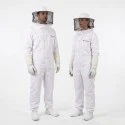 Beekeeper suit with round veil
 Oxalic acid 1kg
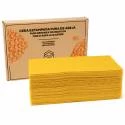 Beeswax Foundation 5kg
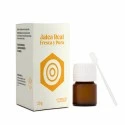 Fresh royal jelly 20g
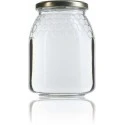 Classic honey jar 1kg comb-lines TO77 - Pack of 16 units
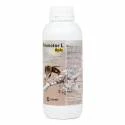 Promotor L Apis 1 litre

 Share in WhatsApp
0–150 mm Pfund COLOUR RANGE | 1 mm Pfund RESOLUTION |
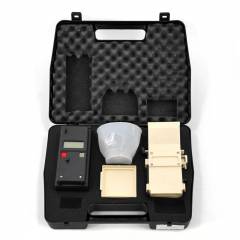
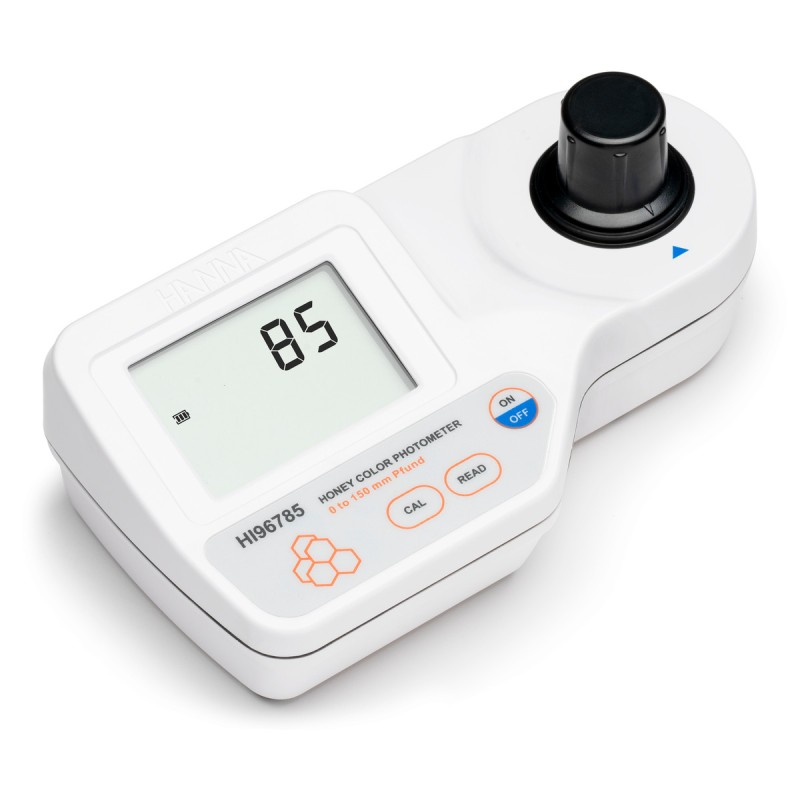
Hanna HI96785 photometer for measuring honey colour in mm Pfund and comparing batches with a numerical reading.
Use it to classify batches, agree a colour specification with a buyer or check differences between harvests. It measures light passing through a sample in a 10 mm cuvette against a glycerol reference. Its 1 mm Pfund resolution is different from the stated accuracy: ±2 mm Pfund at 80 mm Pfund and 25 °C.
01 · MEASUREMENT
Place about 4 ml of glycerol in a cuvette and calibrate with the light shield cap fitted. Use a second clean cuvette containing about 4 ml of honey, follow the orientation marked on the instrument and press READ. The display gives the colour directly in mm Pfund. Keep the optical faces dry and free from fingerprints and scratches: dirt or a different cuvette position affects the light path.
02 · SAMPLE
Use a representative, homogeneous test portion without crystals or bubbles. If liquefaction is needed, control its temperature and let it cool before measuring colour. Our working guideline for warming honey is 35–40 °C: monitor the actual honey temperature and keep heating time short. HMF increases with time and temperature, and stronger heating accelerates deterioration. Spain’s general legal HMF limit is 40 mg/kg (RD 1049/2003, with specific exceptions).
03 · INTERPRETATION
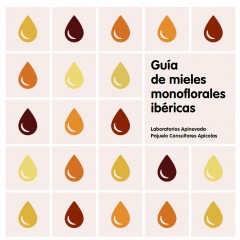
The table gives commercial references from the 2023 Guide to Iberian Monofloral Honeys. Its overlapping ranges support characterisation alongside sensory and pollen analyses. Conductivity is measured separately with a conductivity meter and a prepared solution. The HI96785 measures colour.
04 · BEFORE BUYING
A 9 V battery provides approximately 750 measurements according to Hanna. Five cuvettes, a light shield cap and 30 ml of glycerol are included. Plan for replacement cuvettes and reference solution, and record each result with its batch and preparation conditions.
| Honey type | Colour · mm Pfund | Conductivity · mS/cm |
|---|---|---|
| Acacia | ≤ 35 | ≤ 0.30 |
| Avocado | ≥ 80 | ≥ 0.80 |
| Albaida | ≤ 40 | ≤ 0.30 |
| Alfalfa | ≤ 35 | ≤ 0.30 |
| Almond | ≤ 30 | ≤ 0.25 |
| Forest (blend with honeydew) | ≥ 90 | 0.70–0.90 |
| Ling heather (Calluna) | ≥ 70 | ≥ 0.60 |
| Heather (Erica) | 49–114 | 0.50 to over 0.80 |
| French lavender (L. stoechas) | ≤ 50 | ≤ 0.50 |
| Chestnut | ≥ 49 | ≥ 0.80 |
| Viper’s bugloss (Echium) | ≤ 48 | ≤ 0.50 |
| Wild lavender | ≤ 70 | ≤ 0.40 |
| Eucalyptus | 40–80 | ≥ 0.40 |
| Sunflower | 30–65 | ≤ 0.45 |
| Lemon | ≤ 35 | ≤ 0.40 |
| Strawberry tree | ≥ 70 | ≥ 0.60 |
| Oak honeydew | ≥ 90 | ≥ 0.90 |
| Mountain | ≥ 80 | ≤ 0.80 |
| Citrus blossom | ≤ 45 | ≤ 0.55 |
| Meadow | ≤ 48 | ≤ 0.30 |
| Retama broom | ≥ 70 | ≤ 0.70 |
| Rosemary | ≤ 35 | ≤ 0.30 |
| Thyme | ≤ 84 | ≤ 0.60 |
| Blackberry | 49–90 | ≤ 0.60 |
Source: Guía de mieles monoflorales Ibéricas, 4th edition, 2023, by Orantes, Gonell, Torres and Gómez-Pajuelo. Maximums, minimums and ranges follow the guide. They are neither standalone proof of origin nor universal legal limits. 1 mS/cm = 1,000 µS/cm. Forest, mountain and meadow describe mixed floral sources.
| Model | Hanna HI96785 |
|---|---|
| Range | 0–150 mm Pfund |
| Resolution | 1 mm Pfund |
| Accuracy | ±2 mm Pfund at 80 mm Pfund and 25 °C |
| Cuvette | Square, 10 mm optical path |
| Reference | Analytical-grade glycerol |
| Power | 9 V battery |
| Auto shut-off | 10 min in measurement; 1 h in calibration |
1 file available
Write your question
check_circle
check_circle