 Apipasta with vitamins 15kg
 Beecomplet® Spring 14Kg
 Beekeeper suit with round veil
 Oxalic acid 1kg
 Beeswax Foundation 5kg
 Fresh royal jelly 20g
 Classic honey jar 1kg comb-lines TO77 - Pack of 16 units
 Promotor L Apis 1 litre
- Out of stock

 Share in WhatsApp
28 kg OF HONEY | 21 L WORKING VOLUME |
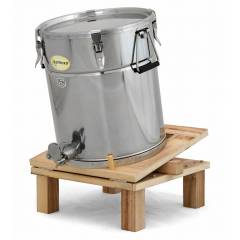
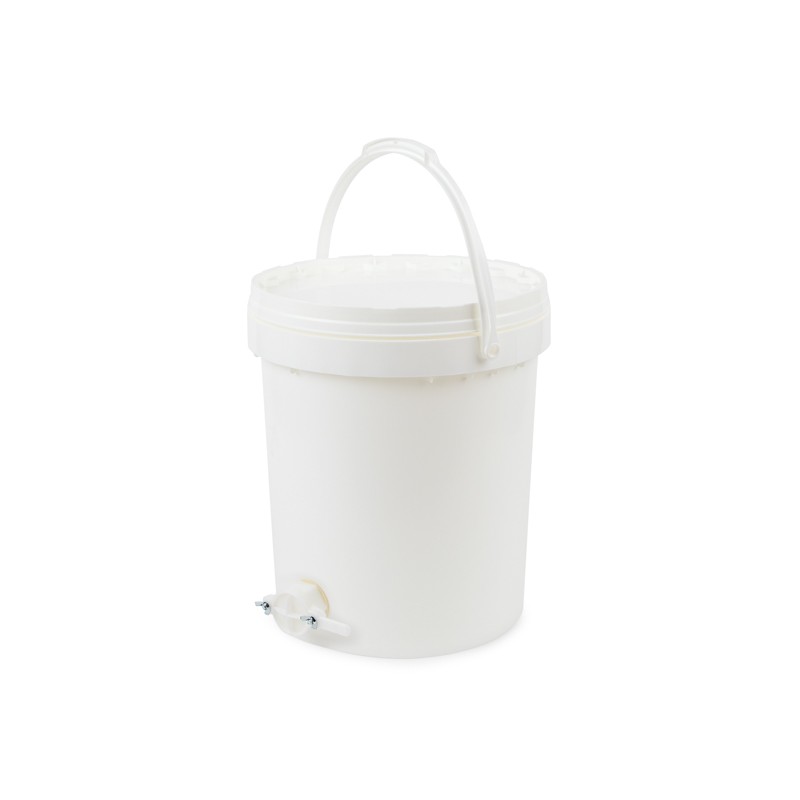
Settling tank in food-grade polyethylene with a gate valve, airtight lid and handle. The honey rests, what does not belong rises, and you bottle from the bottom.
It is the piece that separates extracting from bottling, and in a small apiary it doubles as tank and filling station.
01 · WHY YOU LET IT REST
Straight out of the extractor, honey carries foam, air microbubbles, specks of wax and bits of capping. None of that filters well warm and none of it is worth straining twice: just leave it still. Because all those particles are less dense than honey, in 24 to 48 hours they rise and form a layer on the surface while the clean honey stays below. That is why the tap is at the bottom: you bottle the honey underneath and skim the scum at the end. With dense honey or a cold room, give it longer — settling works with temperature, not against it.
02 · CAPACITY AND SIZE
28 kg of honey, 21 usable litres: the usual size for anyone running 5 to 15 hives. It stands 36 cm tall and is 29.8 cm across at the top (27.3 at the base) — the figures to check against the clearance under your extractor's gate, or the height of the shelf you will bottle from. It is light and has a handle, so it goes from extractor to room, from room to a larger tank, or straight to a market stall. If your extraction regularly exceeds 50-60 kg, you will need two of them or a bigger tank.
03 · THE TAP
The gate valve has an internal threaded fitting, and there is one step not to skip: tighten it fully while the tank is empty. With 28 kg inside the hydrostatic pressure is real, and a half-tightened fitting will weep all night. The other thing to know is that the tap does not sit flush with the base: a few millimetres of honey always remain below its mouth. That is not a fault, it is how any side-mounted tap works — at the end of the run chock the bucket on the opposite side and nearly all of it comes out. Set up high, the whole thing bottles by gravity, with no pump and no decanting.
04 · BEFORE YOU BUY
It is high-density polyethylene approved for food contact: it gives up no odours or flavours, which matters with delicate orange blossom or acacia honeys. Clean it with hot water. The airtight lid is not an extra: left open during settling, honey takes up ambient moisture, and that pushes up the moisture content of the batch.
| ✓ FITS | Settling and bottling harvests of up to around 50 kg per extraction, at home or in a small room. |
| ✕ IT IS NOT | A steel tank for a continuous bottling line, nor a heated vessel. |
| ⚠ NOTE | The tap is not flush with the base: the last few millimetres need the bucket tilted. |
| LTA reference | W7003 |
|---|---|
| Capacity | 28 kg of honey · 21.1 usable L |
| Height | 360 mm |
| Top diameter | 298.5 mm |
| Base diameter | 273.3 mm |
| Material | Food-grade high-density polyethylene (HDPE) |
| Tap | Food-grade plastic gate valve 1½″ (40) with internal threaded fitting |
| Includes | Airtight lid, carrying handle and tap |
| Recommended use | Apiaries of up to around 15 hives |
Data sheet
2 files available

check_circle
check_circle