 Apipasta with vitamins 15kg
 Beecomplet® Spring 14Kg
 Beekeeper suit with round veil
 Oxalic acid 1kg
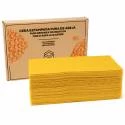 Beeswax Foundation 5kg
 Fresh royal jelly 20g
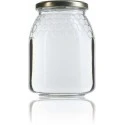 Classic honey jar 1kg comb-lines TO77 - Pack of 16 units
 Promotor L Apis 1 litre
- Out of stock

 Share in WhatsApp
2.5 kg PER BATCH, WITH 250 G OF SEED HONEY | 1–1.5 min OF MIXING PER PASS |
4 °C 24 H CHILLING AFTER EACH PASS | 230 V SINGLE-PHASE, 3.5 A |
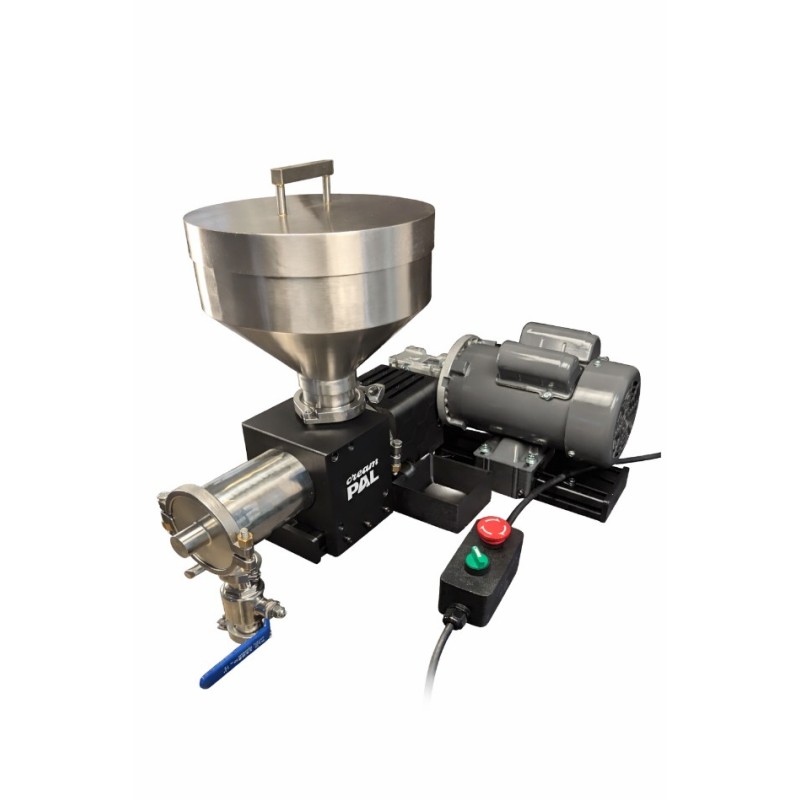
Tabletop honey creamer that turns liquid honey into fine-grained creamed honey in 2.5 kg batches, for beekeepers who want to make creamed and flavoured honey in their own honey house.
Where traditional creaming takes weeks, the CreamPAL Pinnacle works with fully liquid honey and two one-day rests in your fridge.
01 · THE METHOD
Creamed honey is honey crystallised fine and on purpose: it is seeded with honey that has already been creamed, and those micro-crystals act as a template for the whole batch.
In the Pinnacle you pour in 250 g of seed honey and 2.25 kg of liquid honey, and the auger mixes them for 1–1.5 minutes. On the first batch you draw off about 500 ml through the valve and pour it back into the hopper, so no unmixed honey is left in the outlet. Then you empty the machine and leave the honey 24 hours at 4 °C. The next day you repeat the pass, fill jars straight from the valve and they go back in the fridge for another 24 hours.
No seed honey? The machine makes its own: three passes with 24, 24 and 48 hours of chilling. From that batch you set aside 250 g for each run.
FROM THE APIARY
Before the second or third pass, press a finger or a spoon into the centre of the container: the dent should take more than 20 seconds to fill back in. If it closes sooner, it needs more hours in the fridge; this happens mostly with large containers in a small or overfull fridge.
02 · THE STARTING HONEY
The manufacturer sets four conditions: moisture below 17 % for plain creamed honey, no excess feeding syrup, not a single crystal and cold honey, around 15.5 °C (±2 °C), going in. Crystals are what make creamed honey separate in the jar. If yours has started to granulate, melt it, let it cool and wait 72 hours before running it.
03 · FLAVOURS
The flavouring goes in with the honey, on the first or the second pass. Start below 5 % of the weight and taste after 24 hours of chilling: the flavour gets stronger. As a starting point, the manufacturer suggests 3 g of cinnamon or 18 g of cocoa per 450 g of honey. Cocoa gives a milk-chocolate colour if it goes in on the first pass and a darker one on the second. Fruit should be freeze-dried and powdered, because fresh fruit carries too much water. If your honey is around 17.5–18 % moisture, keep it for flavoured batches with powders, which absorb the excess. And on the label, honey with cocoa is no longer plain “honey”: check the product name and allergens before you sell it.
04 · MAINTENANCE
The rear bushing of the auger takes no grease: it is lubricated with 250 g of honey poured towards the back of the hopper at the start of the day, after every clean and every 3 hours of production. To clean it, only the hopper and the safety guard come off and are washed by hand; the rest is flushed with hot water with the machine running until it comes out clean. No wire wool or corrosive products, and don’t leave honey inside at the end of the day.
⚠ PRECAUTIONS
Never run it without the safety guard fixed in place with its pin. Spatulas only above the guard: larger than its 3.8 cm squares and with a handle of 10 cm at most, so that if one drops in it can’t reach the auger, about 18 cm below. No scarves or necklaces hanging into the hopper. Unplug it before cleaning and connect it to an earthed socket.
05 · BEFORE YOU BUY
This is a machine for small-scale creaming and flavour development. Each 2.5 kg batch goes through the fridge twice, so the space you have at 4 °C sets your output. For hundreds of kilos per batch, a tank creamer is the better choice.
Assembled, it measures 69 × 54 × 46 cm and weighs 36 kg: it needs a sturdy table and sits at the edge, as the valve sticks out about 7.5 cm so you can fill underneath. It runs on 230 V single-phase at 3.5 A. Spare parts, warranty and support are handled by La Tienda del Apicultor, official CreamPAL distributor in Spain.
| ✓ FITS | Crystal-free liquid honey, cold (around 15.5 °C) and below 17 % moisture, or up to 18 % with powders. Powdered spices and cocoa, extracts, oils and freeze-dried fruit. |
| ✕ DOESN'T FIT | Granulated honey that hasn’t been melted. Whole nuts, large seeds or chunks of vegetable, which can damage the machine. |
| ⚠ NOT INCLUDED | Fridge or jars. To remove the safety guard and hopper, keep 10 and 13 mm spanners to hand. |
| Intended use | Small-scale honey creaming and flavour development |
|---|---|
| Batch | 2.5 kg: 250 g seed honey + 2.25 kg liquid honey |
| Mixing per pass | 1–1.5 min with auger · about 500 ml recirculated through the valve on the first batch |
| Seeded process | 2 passes · 24 h at 4 °C after each (up to 48 h depending on the honey) |
| Seed honey from scratch | 3 passes with 2.5 kg of liquid honey · 24, 24 and 48 h at 4 °C |
| Starting honey | No crystals or excess syrup · 15.5 °C ±2 · moisture below 17 % (17.5–18 % only for flavoured creamed honey with powders) |
| Honey-contact material | AISI 304 stainless steel in hopper, chamber and auger |
| Components | Hopper with lid · safety guard with pin · outlet valve with sanitary clamp · side cup that catches water from the rear bushing during cleaning · control box with power switch and emergency stop |
| Lubrication | With the honey itself: 250 g at the start of the day, after each clean and every 3 h of production |
| Cleaning | Hot water with the unit assembled · hopper and guard washed by hand · 10 and 13 mm spanners |
| Power supply | 230 V · single-phase · 3.5 A rated · rating plate: 240 V · 4 A · 50/60 Hz |
| Dimensions | 69 × 54 × 46 cm assembled, excluding the valve, which sticks out about 7.5 cm |
| Weight | 36 kg the machine · 46.7 kg in its 72 × 46 × 46 cm box |
| Manufacturer’s warranty | 3 years on all components, except motor and gearbox: 2 years |
The manufacturer’s process videos.
check_circle
check_circle