 Apipasta with vitamins 15kg
 Beecomplet® Spring 14Kg
 Beekeeper suit with round veil
 Oxalic acid 1kg
 Beeswax Foundation 5kg
 Fresh royal jelly 20g
 Classic honey jar 1kg comb-lines TO77 - Pack of 16 units
 Promotor L Apis 1 litre

 Share in WhatsApp
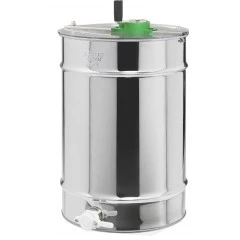
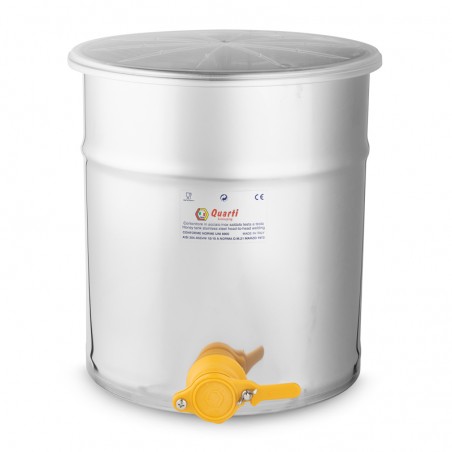
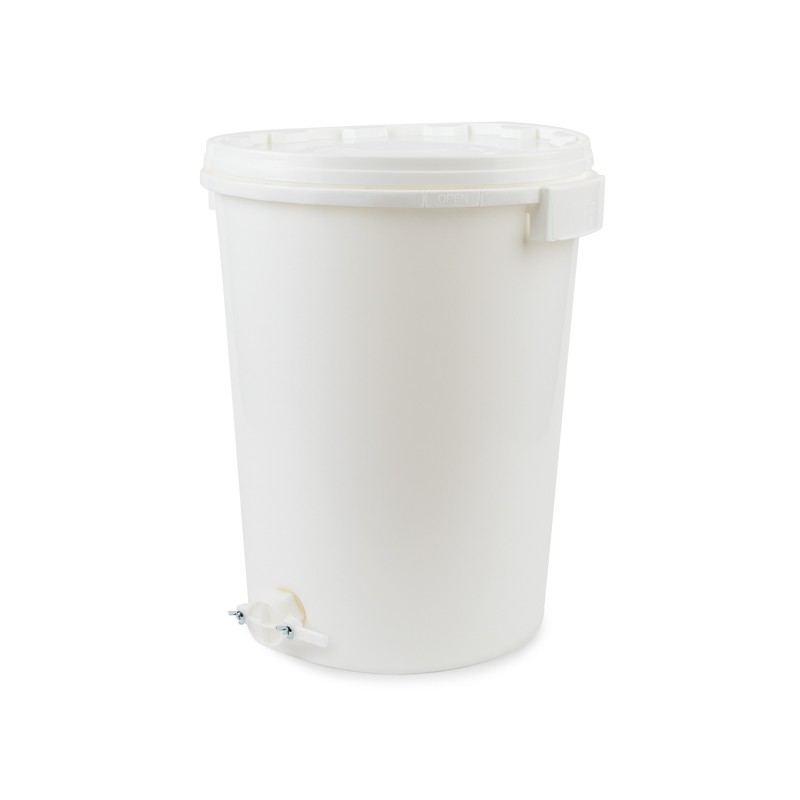
Food-grade polypropylene settling tank of 46.3 litres under the lid — of the order of 65 kg of honey — with a bottom gate. 374.7 mm across and 504 tall.
Between this and the 80 kg tank the diameter does not change: the height does. Both measure the same across the top, so they share lid, strainer and stand.
01 · WHICH OF THE TWO
It is the natural question in this family and it settles quickly: both tanks have a top diameter of 374.7 mm and differ in depth — 504 mm this one, 668 the big one. That means two things. That everything resting on top fits both, strainers and stands included; and that this one goes under low extractor outlets and onto shelves where the tall one will not. If the space decides more than the kilos, this is yours.
02 · WHAT IT DOES AND DOES NOT
Honey straight off the extractor carries bubbles, foam and fine particles. During the rest, part of that rises and is skimmed before bottling, and how much rises depends on viscosity, temperature and the time you give it. It is worth saying what it does not do: it does not replace a filter, nor does it correct excess moisture. If the honey came in wet, the tank stores it, it does not fix it.
03 · THE LID
Honey is hygroscopic: it takes up moisture from the air, and smells with it. Keep the lid on throughout the rest and the storage, and keep the container somewhere cool, dry and clean, away from sun and from heat sources that could distort the plastic. Identify each load with its batch: the container keeps the honey, but traceability comes from your records, not from the vessel.
04 · THE MATERIAL
The container is polypropylene with a declaration of conformity for food contact under the applicable European regulations. The maker leaves the hygiene procedure to the user: wash and dry it before the first fill and between batches, and avoid abrasives that scratch the inside, because every scratch is a place where old honey stays.
05 · BEFORE YOU BUY
Test the gate with water and the container empty before the first load, and leave room under the outlet to get the jar in without contorting yourself.
| ✓ FITS | Settling and bottling batches of up to about 65 kg, and places where the tall tank will not go. |
| ✕ DOESN'T FIT | Warming the honey, or using it full as a transport container. |
| ⚠ NOT INCLUDED | Strainer, raising stand or scales. |
| Material | Polypropylene for food contact |
|---|---|
| Volume under lid | 46.3 litres |
| Brim volume | 47.4 litres |
| Capacity | Of the order of 65 kg of honey |
| Top diameter | 374.7 mm |
| Height | 503.8 mm |
| Outlet | Bottom plastic gate |
| Reference | JG284 |
Data sheet
2 files available

check_circle
check_circle