 Apipasta with vitamins 15kg
 Beecomplet® Spring 14Kg
 Beekeeper suit with round veil
 Oxalic acid 1kg
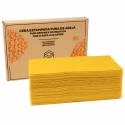 Beeswax Foundation 5kg
 Fresh royal jelly 20g
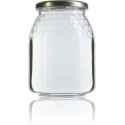 Classic honey jar 1kg comb-lines TO77 - Pack of 16 units
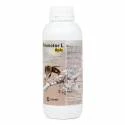 Promotor L Apis 1 litre
- Pack


 Share in WhatsApp
6767 ,00 €
Swienty DANA 1000 bottling line with a Ø70 cm rotary table and wire switch. Doses from 10 g, within ±2 g, into jars of Ø30 to Ø120 mm and up to 290 mm high.
The machine doses volume. You sell weight. That is where the one routine you cannot skip comes from: calibrate against a scale.
01 · WHICH JARS THE TABLE TAKES
The range runs from Ø30 to Ø120 mm across and 30 to 290 mm high, and the filler adjusts vertically and horizontally to suit the format. Ordinary round jars go on without discussion.
With non-round containers — square, hexagonal — what governs is the diagonal: if it fits within the 120 mm and the jar stands firm as the table turns, it works. What a rotary table will not forgive is a tall, narrow jar that topples, so with unusual formats test before committing to a run.
02 · IT DOSES VOLUME, YOU SELL WEIGHT
The system is volumetric and honey is sold by weight. Since density changes with moisture and temperature, the same setting will not give the same grams with two different honeys, nor with the same honey at a different temperature.
The routine is fixed: weigh the first jars of every batch and readjust, then check again if you change honey or the room temperature shifts. The machine's margin is ±2 g per dose, but that figure is the repeatability of the doser, not a guarantee that you have hit the nominal weight.
03 · THE HONEY HAS TO FLOW
The pump moves about 270 kg of honey an hour, around 200 litres, and the table turns at 1 to 7 rpm: the real pace is set by the table speed and the jar size. That rate only holds with fluid honey: one starting to granulate clogs the doser and throws the dose off.
Warm it, yes, but with the ceiling in place: above 40 °C honey pays in HMF. A room at 25-30 °C and honey properly settled is what makes the line deliver what it promises.
04 · THE LINE AND THE SPACE
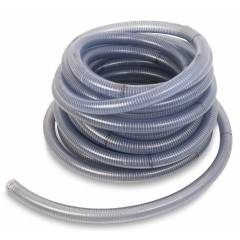
The connections are inch and a half — the standard honey-house size, the same as an extractor tap — so it joins the usual hoses and gaskets with no adapters.
It occupies 90 × 74.5 cm: it wants a fixed spot and a solid floor, not a makeshift table. It arrives in three boxes and takes about half an hour to assemble with the manual. It comes with pedal, hose, counterflow valve and dosing syringe, and draws 230 W at 90 to 264 V.
05 · BEFORE YOU BUY
Measure your jars and check they stand firm on the table. And plan for a scale beside it: the dose is calibrated on every batch.
| ✓ RIGHT FIT | Serious runs with a stable format and fluid honey. |
| ✕ WRONG FIT | Granulating honey, or containers that will not stay upright as the table turns. |
| ⚠ NOT INCLUDED | Scale, labeller or feed tank. |
| Maker | Swienty, Denmark |
|---|---|
| Table | Rotary Ø70 cm, with wire switch |
| Jars accepted | Ø30 to Ø120 mm · 30 to 290 mm high |
| Filling range | 10 g to 999,999 g |
| Rotation speed | 1 to 7 rpm, adjustable |
| Pump capacity | About 270 kg/h of honey (200 l/h) |
| Accuracy | ±2 g per dose |
| Connections | Inch and a half BS, and inch-and-a-half hose |
| Power | 90-264 V · 50/60 Hz · 230 W |
| Includes | Pedal, counterflow valve, 0-60 ml dosing syringe, Ø20 cut-off cross, legs, 1½" hose with bend and clamp, and a spare parts kit |
| Size | 90 × 74.5 cm · ships in three boxes |
Data sheet
3 files available
Write your question
check_circle
check_circle